1.Cape Town has a Mediterranean climate. Hot in summer and wet in winter. Average summer temperatures are around 20’C and winter temperatures average around 15’C. Daytime temperatures are warm to hot. Winter rainfall is around nine days a month. Summer days are usually dry.
2. Tipping is expected. A tip of 10% on the total bill is customary. If a 10% “service charge” is added to the bill for a party of six or more, then an additional tip is not required. We once had a “service charge” added to a light breakfast for two at a well known vegetarian eatery in Long Street. That was really cheeky. Keep an eye open for this “service charge” so you don’t end up double tipping.
3. The five traditional MUST SEES are Table Mountain; Robben Island and the V and A Waterfront; Cape Point and Chapman’s Peak Drive; The Winelands and Kirstenbosch Botanical Gardens.
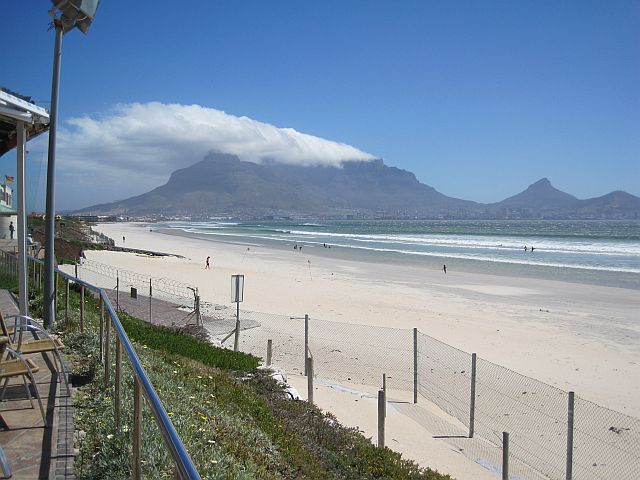
Camps Bay Beach, Cape Town
4. Since everyone is trying to see the same attractions they do get crowded. You can buy a ticket in advance from – Webtickets to avoid queuing up on the day.
5. Table Mountain and Robben Island are weather dependant attractions so make sure you get them done early in your stay in case you have to come back due to bad weather.
6. The MiCiti bus from the airport to town is an absolute bargain at just over R50 a head. It takes you to the Civic Centre in the heart of Cape Town. From there you can catch either a train, another bus or a taxi to your accommodation. MiCiti are also worth considering for getting about Cape Town. A trip from the city to Blouberg costs around R10 and covers more or less 20 kilometres.
7. I recommend Rikkis taxis for getting about. They are London style cabs. You can ride a “share cab” from one end of the city to the other for approximately R40. Find them on-line at Rikki Or you can phone them at 0861 745 547.
8. Search through this Cape Town oriented travel blog for loads of ideas about where to go and what to do. There are photos accompanying each post. Fancy a train ride to Simonstown right alongside the sea; or a bike ride to Blouberg passing Milnerton lighthouse and Flamingo Vlei? It’s all there in older posts.
9. While most locals use mini bus taxis, and they are without doubt the most cost effective way to get around, I don’t recommend them. They are inclined to be a law unto themselves and have the highest stats when it comes to vehicle accidents. They should definitely be avoided at night.
10. Hiring a car is easy in South Africa and most airports have the usual companies well represented. Do be aware that is illegal to park on a yellow or red line anywhere in South Africa. It is also an offence to park on a pavement or facing oncoming traffic. You must park facing the direction you were driving. South Africans drive on the left hand side of the road. Roads in South Africa, particularly in the urban areas are good. Be aware that some regions have an abundance of toll roads.
Milnerton Beach, Cape Town
11. Although South Africans have not done enough to counteract driving under the influence of alcohol, authorities are committed to cracking down hard. Roadblocks are becoming more and more common. Stop and searches for drugs are increasing. Just say no.
12. The sale of alcohol is forbidden on Sundays in South Africa. It is possible to find the odd place with a special alcohol license if you are stuck on a Sunday. Ask around. And you can’t buy beer or spirits in supermarkets. Only wine.
13. Tap water is perfectly safe to drink in the major cities in South Africa. Avoid drinking water in rural areas, unless you know that it is safe.
14. Not all petrol vendors accept credit cards. They have only recently been introduced and some places have catching up to do.
15. It’s illegal to consume alcohol on the beach or public places. But, you can take a basket of snacks and a bottle of wine up Table Mountain or to Kirstenbosch Botanical Gardens. I can’t explain this discrepancy.
16. People forget or don’t realise that South Africa has 50 million people. Cape Town alone has close on 4 million people. We get asked if our guesthouse is close to the beach or the mountain. There are lots of beaches and mountains in Cape Town. I suggest that people allow at least 3 – 5 days in Cape Town. It’s best to be centrally located as most of the attractions are in and around the city.
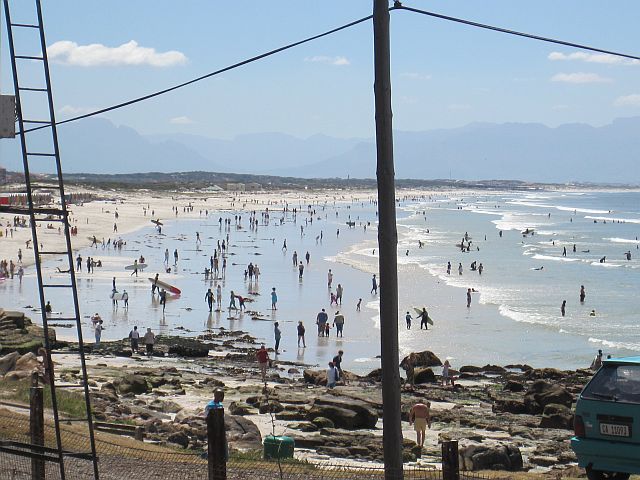
Muizenberg Beach, Cape Town
17. South Africa has self-appointed car guards all over the place who “guard” your car. Some of these people are desperate refugees from Africa with no status in South Africa. Being a guard is the only source of income for them. Others are common criminals or drunkards who wouldn’t be able to tell a car from a rock. Do you tip them? It’s your call. If they can stand on their feet and speak coherently, I tip. If not, I don’t.
18. Cape Town has some excellent Blue Flag beaches but the seawater is cold. The Indian Ocean is warmer and is on the False Bay side of the Cape Peninsula. Muizenberg and Gordon’s Bay will have warmer sea. On the Camps Bay side of the peninsula is the Atlantic Ocean and it is definitely cold.
19. The standard of accommodation and restaurants in South Africa is generally high and usually great value. You should find South Africans are a friendly and helpful nation. You can expect good service.
20. Cape Town International Airport is approximately a 20 to 30 minute ride from the city centre. If you are driving, make sure you budget extra time during peak hour traffic. The N2 highway to the airport can get very congested and traffic stands still.
Go to – My Holidays and Trips – at the top of this page to read about other places we have visited. Or just click on – this link.
Most of the guests who stay at our guest house hire a car. I thought I would do a blog about the roads and road safety in South Africa.
South Africa is a lot bigger than most visitors realise. It is also a lot more developed than many parts of Africa. We were smiling at a dinner the other night, about a tourist who arrived at the airport in Johannesburg, and thought he had gone to the wrong destination. He could not believe such a large happening airport existed in Africa.
South Africa is located on the southern tip of Africa. It’s a long haul destination. We have 2798 kilometers of coastline. Our country comprises around 1 223 100 square kilomteres of land and occupies 4% of the land in Africa. We are around 50 million people and have 11 official languages. There are plenty routes to drive and lots to see. Big bonus is our favourable climate year round. Driving holidays are a great way to see South Africa.
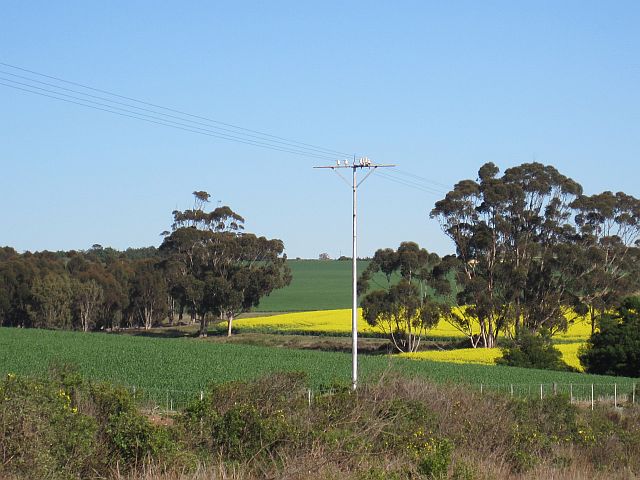
Rapeseed fields along the N2 Motorway
Our roads and infrastructure are generally good. Car hire is easy. In the last blog I gave some links to compare car hire prices in South Africa.
Car hire may be slightly expensive compared to some countries. Petrol prices are creeping up but we are still cheaper than most Western countries. I remember visiting Dubai and being stunned at how cheap petrol is there.
Dassiesfontein road stall
Public transport in South Africa is not what it is in Europe. Driving is essential for some people to get about. Road signs should be recognisable. There are speed limit signs so you don’t have to guess. Our local roads almost always have a verge or emergency lane, should you need to stop.
Here is a link to an article for more on driving in South Africa – driving in SA.
The main things to remember are to drive on the left, make sure you can pay for petrol in cash, ignore taxi drivers (they are a law unto themselves) and always know exactly where you are going. For AA maps follow this link – AA route maps.
Two local magazines aimed at driving holidays are Getaway and Go. You can read them on-line.
One of the best bits of doing a road trip in South Africa is the farm stalls, cafes and various vendors along the routes. It’s not uncommon for farmers to sell fresh fruit and vegetables, honey and jams or other interesting foods at stalls on the side of the road. You may get plied with tastings of luscious fresh foods.
Roadside cafes can get really cute. I showed a few pictures in this blog of Dassisfontein along the N2. Read more about them here – Dassiesfontein farm stall. A translation of the name means rabbit river. But there are plenty of quaint and fun roadside stops. Speciality meals and souvenirs abound.
Table setting at Dassiesfontein
We also have the usual petrol stop fancourt type places where you fill up and take a biological break.
There is a really comprehensive list of travel tips on this web page – tourist travel tips.
But the usual and I would hope obvious safety precautions apply. Make sure you rent from a reliable car hire company. Make sure you know exactly where you are going or be guided by locals as to where to travel. Don’t leave valuables or anything visible in the car. Don’t talk to beggars or street children at intersections. It has been known to happen that these people grab your bag or camera through an open window. It is illegal to talk on a mobile while driving in South Africa. It is also illegal to park facing oncoming traffic.
Go to – My Holidays and Trips – at the top of this page to read about other places we have visited. Or just click on – this link.
The Garden Route is a popular holiday and retirement destination. Coming from Cape Town, it begins around Albertinia which is a tiny and not too exciting place. Give it a miss. The first coastal town is Mossel Bay (Mussel Bay). Mossel Bay is hardly a town. It is a big place and the road passes through the outskirts of it.
The other end of the Garden Route is at the Storms River Mouth. Place names like Natures Valley and Lake Pleasant give a clue to the beauty that this area holds. A mix of lakes, lagoons, estuaries, rivers, forests and mountains are what make it such an attractive place.
Dwarf and mini horses for kids to stroke. This is Henry.
You can get there by hiring a car and driving. Visit these links for price comparisons of the various car hire companies in South Africa – option 1 and option 2 and lastly option 3. The roads have recently been re-done and long queues seem to be over for the most part. The views along the way are special.
Bus companies to consider are Baz bus which is a hop-on hop-off bus. Links to other inter city coach bus operators are Intercape, Greyhound and Translux.
Maybe you might like to do a motorbike trip through the Garden Route? Follow these links – MotoBerlin and AdMo. Have yourself a Harley holiday.
Garden Route sand and castles
I would be wary of the intercity trains. I read the local news and I don’t feel I can recommend them. The Blue Train or a special train is fine.
There are organised cycle tours. I have included a link for those who would relish a chance to sit on a saddle and cycle – mountain biking in South Africa.
I would strongly discourage anyone from hitch hiking in South Africa. And I’m not sure I would couch surf either. I know of people who have done some couch surfing in SA, and maybe it’s just me, I don’t like to take that sort of risk.
Go to – My Holidays and Trips – at the top of this page to read about other places we have visited. Or just click on – this link.
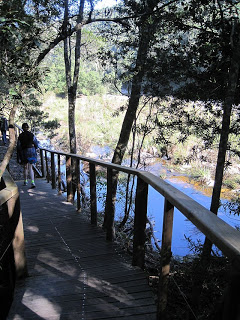
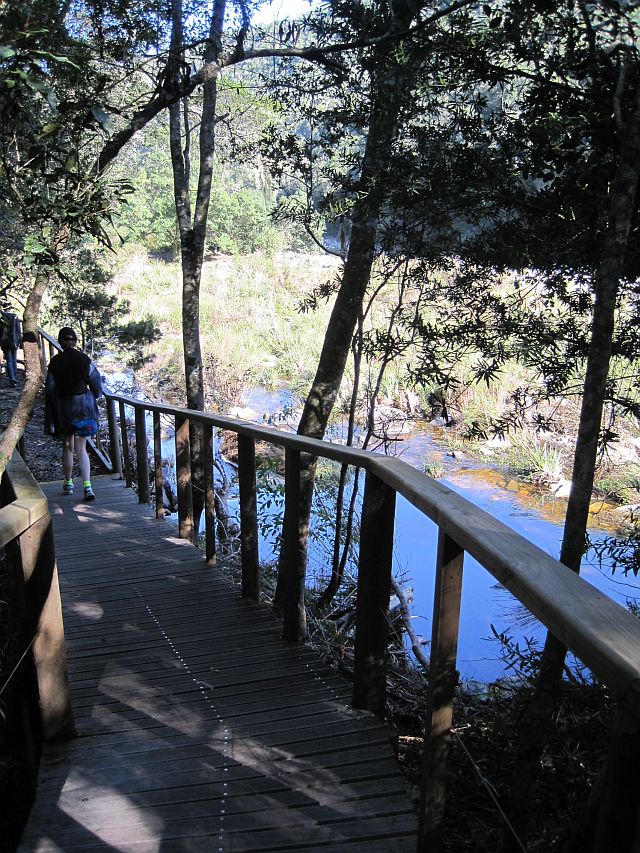
I mentioned in the last few posts that I spent a week in the Garden Route. We took a day trip to Wilderness twice. The first time we took a relaxed approach. We had a meal and wandered around the shops. The second time we decided to paddle a canoe up the river, into the forest, for a picnic.
The river and the forest are set in the Garden Route National Park. Click on this link for more – Garden Route National Park.
I have to be a bit honest. My canoeing skills are not all that. We rowed against the tide when we went for our picnic and when we came back as the tide had turned. My arms ached. The river got a bit rocky in places and we had to get out and push our canoes to get them going again.
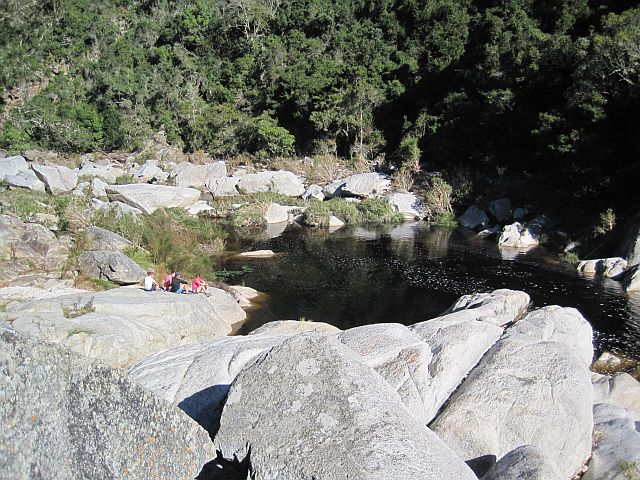
The river water was freezing cold. I couldn’t feel my feet. But it was fun. Once we arrived at the waterfall area we relaxed in the sun, listened to the birds and the water splashing in the rock pool. I could barely move after a while. It’s definitely one way to de-stress.
Canoe boat
The company we got our canoes from is Eden Adventures. Follow this link to find them – Eden Adventures. They have all sorts of activities for a person to do.
We passed wooden lodges and rondavels as we paddled the river. SA National Parks hire them out to visitors. Go back to the first link for our local national parks and find out more there. They even have a webcams so you can view wild animals.
What is a rondavel? It’s a unique South African word for a round dwelling. Wiki explain all here – Rondavel.
Rock pool
Wilderness area also has a long soft sandy beach. The sea water is warmer than in Cape Town. Sea water gets warmer as you head up the coast toward Durban.
The Garden route is definitely a must-see. It’s the Garden of Eden of South Africa. You can do nothing more than simply soak up the scenery. Or you can get more adventurous and go canoeing, visit the Cango Caves nearby in Oudtshoorn or ride an elephant in Knysna. You will find plenty to suit your inclinations.
I spent a week in Sedgefield when I went to the Garden Route recently. The Garden Route is a magnificent area on the south eastern coast of South Africa. It is a mix of lakes, forests, breathtakingly beautiful beaches and lush verdant vegetation. Each area has it’s own distinct character.
Sedgefield is South Africa’s very first slow town. It has been confirmed by Cittaslow so it must be true.
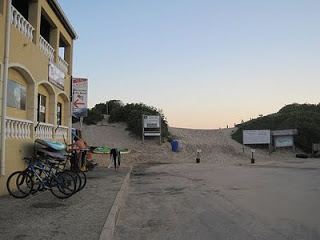
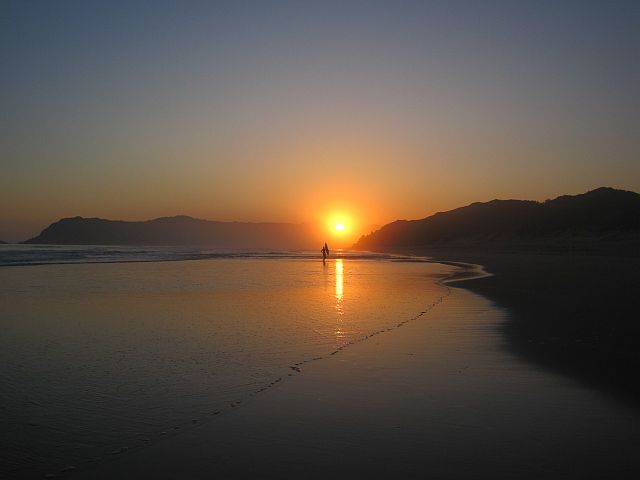
A surfer strides into the sunset on Myoli beach
Sedgefield might not have the glamour of Plett or Knysna but it certainly has a lot more charm. There are massive and inviting soft sandy beaches. Tranquil lagoons, plenty bird life including flamingos and the ocean is home to whales, dolphins and other marine life. Who would want to shop with all this natural beauty?
A tortoise – reminder of Sedgefield’s slow town status
I would recommend a visit to the Wild Oats Organic Market on a Saturday morning. I would also suggest taking a cycle trip on one of the many magnificent routes. What better way to spot a Malachite Kingfisher or any one of the birds in the area? There are hides to view the bird life on the lakes.
A walk to watch the setting sun on one of the beaches is a MUST. And behind Spar is an Italian restaurant. Trattoria da Vinci. You have to eat there. Well priced, relaxed easy atmosphere and fabulous food. I had an aubergine parmigiana. It was excellent.
Google Tourism Sedgefield for more on Sedgefield Tourism and do pick up their brochure. It’s free and lists cycle routes, hides, hikes and more.
Go to – My Holidays and Trips – at the top of this page to read about other places we have visited. Or just click on – this link.