Read this travel blog from the start on – this link.
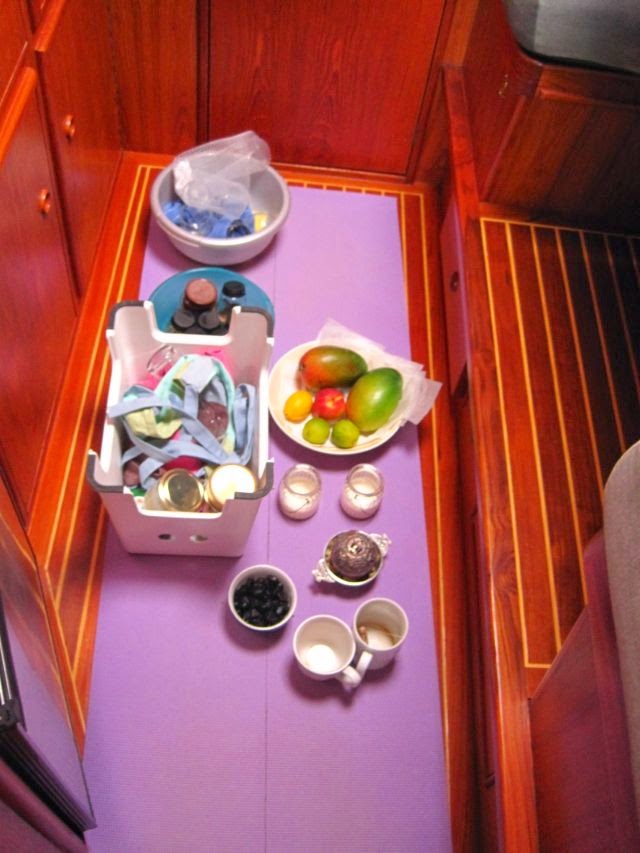
Stowing our kitchenware before heading to the IJsselmeer
Or start here.
We took a stroll and looked at a few private marinas. Some of them have gyms, saunas, luxurious bathrooms with unlimited hot water, high speed Internet, cafes and bars right on your boat doorstep. You pay more for all that. We desperately needed to do some washing so we decided on the first marina as it had a washing machine and Internet.But first we had to get there.
Greenie in gale force winds
We snuck onto the edge of the IJsselmeer via Lemstersluis. It’s incredible, the minute you move off the inland waterways into wide water and closer to the sea, the weather conditions change. We made sure to check the forecast first. Although the IJsslemeer is now a lake, it was once the Zuider Zee. The water can get quite rough. Our boat was rolling back and forth as force four winds blew behind us with wave heights of 1.2 metres.
I had hoped we would spend more time on the IJsselmeer but my other half wasn’t willing to chance it. We made sure to stow our glassware and breakables safely before we got going.
At the new marina a couple crashed their hired yacht into the posts of their mooring. They were quite obviously inexperienced. The wind was dragging and spinning their boat and they had no idea what to do. The harbour master
Trying to dry our clothing
came and guided them alongside. They made at least 5 or 6 attempts while my husband and the harbour master held their boat ropes and eased their boat in. No wonder boat hire companies require such hefty deposits!
We got going with the first of three loads of washing only to discover the marina had no dryer! And no washing powder. That was a
Greenie after slamming finger in hatch
first. It was too late to move. We walked to Lemmer beach to kill time. And then the rain came down. It rained and rained and rained. We had to make washing lines at the back and inside the boat. There was washing all over the place. We were ducking to move around our boat.
The view from a cafe in Lemmer
We don’t shave or wash our hair on the boat as it has a micro fine filter that clogs easily. If the filter blocks up then our shower water can’t drain. The filter is probably there because the boat pumps water out as opposed to water draining.
Sunset en route to Emmeloord
So we have use a marina shower every other day. Anyone who thinks boating is glamorous is either an oligarch or good friends with the likes of Bill Gates et al. Ordinary, everyday boating is not always comfortable.
I was feeling a right mess. My hair was due for a wash, my hands were rough and dry from rope work, my front tooth had chipped, my finger nail was blue from slamming it in a hatch, my clothes were creased or wet, I had bruises on my legs and I looked like I had measles from mosquito bites ALL OVER my body. Plus, I reeked of garlic from munching whole cloves at every meal to deter the
Catching up with Internet in Lemmer
mozzies from devouring me.
The last time I wore smart clothes and make-up was a while back. On the boat I live in tracksuit bottoms, T-Shirts, a windbreaker, a peak hat and light soled slip-on canvas shoes. The closest I get to grooming is brushing my teeth and putting on sunscreen. Our boat is big compared to others but the portholes are small and lighting is poor. And there really is no space. It’s not uncommon to see people brushing their teeth on the back of their boat, rinsing from a bottle of water and spitting overboard.
My husband cooked a vegan cauliflower cheeze with soy mince in a yummy tomato gravy. And he got the heating going on our boat. We spent the evening relaxing, paying bills and catching up with communications while we had Internet.
Read about this journey from the start by clicking on – this link – or to go back to the last post click – here.
The weather had been slowly changing and by early evening the heavens opened in Heeger Meer. I felt so sorry for people in tiny boats. Some had erected tents on the banks of the lake. They were standing in rain proof gear, trying to cook food under umbrellas.
Amenities at Heeger Meer were really basic. A row of 4 loos and an outside basin. That was it! Most amenities are single gender but some, like in Groningen, are mixed. In Leeuwarden and in Lemmer a bloke just
Sailing on the Heege Meer
walked into the ladies shower while I was there and didn’t seem too fazed to see me.
The next morning, it was still cold and dreary. And a Sunday. We decided to hang around Heeger Meer another day. After lunch the weather suddenly cleared up and the sun came out. A friendly Dutch woman from the boat across the way was walking her dog. She came up to us and greeted. We must have spoken for about 45 minutes.
The next morning her husband walked the dog and he also chatted with us for quite some time. As is custom, they offered us a coffee. Conversation and coffee go together in The Netherlands. Dutch people
Sunset at Heege Meer
LOVE their coffee. We noticed massive 2 kg bags of coffee beans for sale in their food stores. Those would be for commercial use back home!
Before we untied I went to see where the sound of running water was coming from. There are no mountains in this part of the world. A dijk is as good as it gets so I knew it wasn’t a river.
Our mooring for the night was on a mini island in the lake. It was the sound of water from the wind splashing on the banks of the lake.
But . . I found a big fat bush of blackberries. I grabbed my other half and we filled two big bowls with fresh blackberries which went into our breakfast smoothie.
Old Dutch boats in Lemmer
The next part of our journey was toward Lemmer via Slotermeer, Brandemar and Grutte Brekken. The maps seem to alternate between Frisian and Dutch place names. Not sure which name is which. I guess they refer to the most commonly used name first. We thought we would motor straight into the centre of
Blackberries
Lemmer and tie up.
The bridge man let us in – no problem. The harbour DID look crowded but we thought there had to be space further ahead, or why would he have let us pass?
But no, the harbour was chock-a-block full. We turned around and were heading out when the bloke at the bridge said we can double bank. Basically park abreast of another boat.
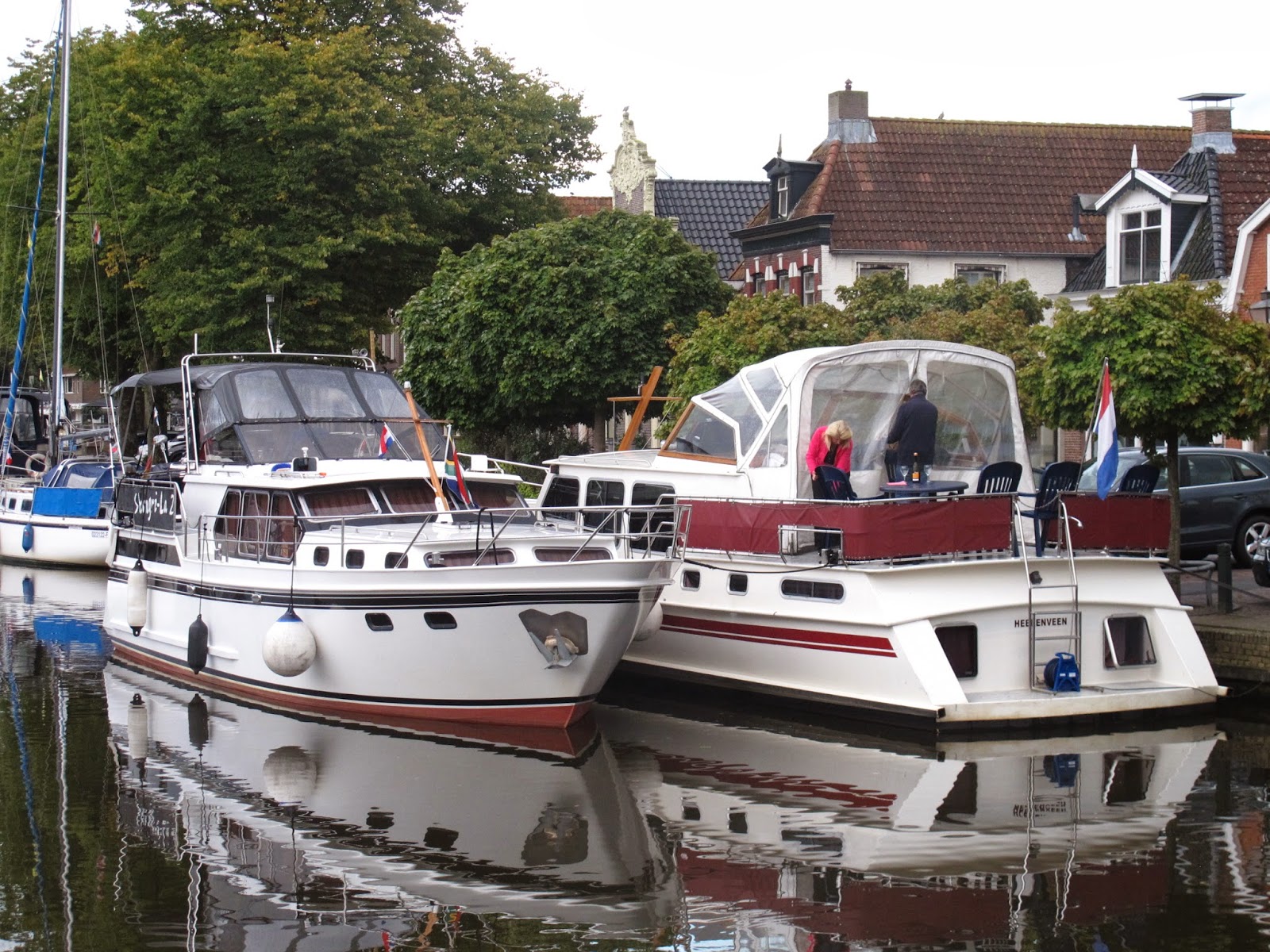
It was a group of Germans and they seemed amenable to the idea, so we tied up to their boat. It does feel a bit strange stepping all over someone else’s boat to get shore power and to go to the shops. That’s how it’s done.
Lemmer is an old fishing town that came to a halt when the Afsluitdijk
Lakeside at Heege Meer
came into existence in 1932. From then on Lemmer had to rely on boating and tourism. It has a LOT of yacht harbours, camping and a white sandy beach. Not many beaches in this part of the world. There are plenty cafes and bars along the canal and a person is spoilt for choice if you want to eat out. We found a fabulous organic food emporium with a deli, fresh produce, store cupboard staples, personal products and certified organic wines selling at 3 bottles for €11.
Sundowners onboard Shangri La
We opted for a central public mooring. The amenities were not great. But, it was a lovely location. However, after one night we decided to move to a privately owned marina with more facilities. We had been without Internet for three days, the electricity dispenser was swallowing €1 coins as opposed to 50 cent pieces everywhere else. The lights kept going off and the kettle wouldn’t boil. Fiddling about with coins in a shower or at the electricity meter in the dark was most frustrating.
To go back to the beginning of this trip – use this link. And if you want to go back to the previous post –use
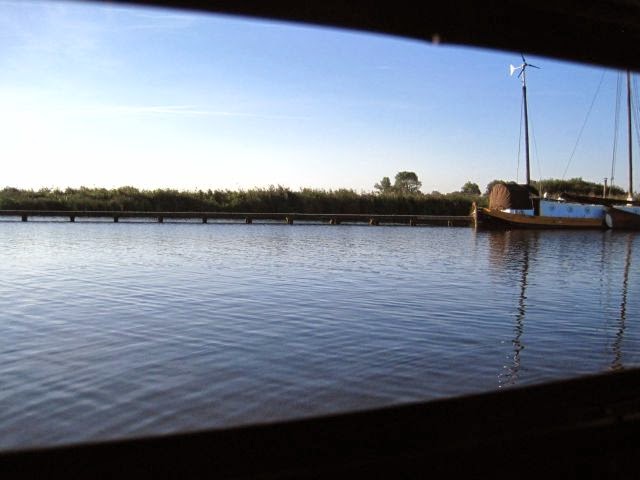
View from our bedroom porthole
this link
At this point we had been on the canals for just short of a month. The boat was our home. We’d been buying odds and ends like spice jars and spare fenders to make it just the way we wanted it. We also worked out that the most obvious routes on the map might not be best for us. Our original intention was to travel along the Princes
Moorings in Lemmer
Magriet canal.
However our boat is small enough to fit on the narrower and shallower canals. Bigger canals are used by large working barges, which always have right of way. The big canals are geared toward commercial traffic on the banks and often have a rather industrial look.
In contrast, the smaller canals pass through farms, little towns and are only used by pleasure craft. But then bridge and lock hours are restricted and waterway heights and depths have to be considered.
My husband keeps a boating travel log. Not obligatory, but not uncommon. He notes travel times, distance travelled, engine hours, routes
Beach in Lemmer on a drizzly day
taken and any maintenance done. He bought a RYA (Royal Yacht Association) blank book specifically intended for motor cruisers. Their guide had WAY too much detail which he never filled in. But he also wanted to log other things that they didn’t allocate space for. It may seem tedious but we often found ourselves referring to his log book. Simple things like place names where we over-nighted or the length of time it took to travel a certain distance. Even info like when last we cleaned the filter for the shower pump proved to be very handy.
Beach cafe in lemmer
From Sneek we set south toward Lemmer intending at least one “wild” overnight stop. We did a shop-up at Albert Heijn and stocked our little fridge and cellar before leaving. Shopping hours in the Netherlands can be a bit perplexing. Even large cities like Amsterdam shut down on a Sunday. Mondays are late starting if at all. Thursdays and sometimes market days – whatever day that may be, have late shopping hours. So it’s wise to check shop opening times with either the VVV (tourist info) or haven meester (harbour master) to avoid being without food and provisions.
We cruised through a gorgeous little town called IJlst with a narrow canal that caused a mini traffic
Dutch and Fries place names on map
jam. We had been led to believe that the Dutch are inclined to push ahead in queues and are not aware of the British – ‘wait your turn’ – ethos. I have to say, I saw only three boats blatantly shove in front. Like switch their engine to full throttle, overtake, and race ahead of a boat. One with a German flag and two with a red British ensign. It happens every now and again. However, just because a boat flies a particular flag, does not mean the driver is from that country. People from all over the world hire boats. We could easily have registered our boat via our broker in The Netherlands. Our boat flies the British ensign but
Our deck on Shangri La
we live in South Africa. My husband’s cousin was happy to be his representative person in the UK.
Flag protocol says that you fly the flag of the country where your boat is registered at the back or at the stern. This is the most important flag. Next, you have to fly a courtesy flag, of the country you are in, on the right or starboard side of the mast. You can fly as many flags as you want after that. But you fly them alternating left to right, and from the outside inward. We flew a South African flag on the left or port side of our mast. Dutch people fly regional flags and yacht club flags. We even saw football flags and fun pirate
Drying our washing on the aft deck in rainy Lemmer
flags. So there you go!
We made good time and ended up stopping early at a space on the Heeger Meer (Heeger Lake). Very, very shallow, with only 30 centimetres of water below the boat, which made mooring or parking the boat difficult. The less water the boat has to move in, the less space for water to displace. It has the effect of sucking or pushing the boat. Revving the engine or bow thrusters only worsens the problem causing the boat to be pushed or sucked even more. It requires a gentle, slow approach. I’m not ready to tackle that just yet.
Leeuwarden is the capital of Friesland. It’s a city with a rich history. You will find a nice big VVV (tourist info) at the south end of the old city where you can get a free map with all the must-sees.
We went to Oldehove leaning tower which has free access. Apparently on a clear day you can see the Friesian Islands. The tower is 1.68 metres off true so you can easily see that it leans. I’m a claustrophobe. The stairs up to the top were dark and full of people so I gave that a miss.
Boomsma’s Distileerderij do a guided tour, but it’s closed Sundays and Mondays, so we never got to do that. There’s also Grote Kerk, Prinsen Tuin and various museums to Friesian history and culture that you can explore. Even just walking along the canal/moat is great. Every town or city seems to have a Pannekoek Schip where you can eat Dutch pancakes. They love their pancakes savoury or sweet. You can even buy take-out pancakes at the supermarkets.
Pannekoek schip
And every town or city has church bells that chime long complicated tunes. As we were leaving Leeuwarden we passed a free standing bell statue come artwork that played a tune with the varying bells. Yet another thing the Dutch love to do is erect statues or artworks all over. The theme with Leeuwarden was the resistance movement. In Appingedam they had statues of people kissing. We saw a massive metallic mural right next to one of the canals. Next to the motorways, even under the bridges in Groningen, you will spot art, both classical and contemporary.
Pik Meer
We left Leeuwarden and overnighted at a public space in Pik Meer. I LOVE middle of nowhere spots. Nothing but the sounds of water slapping against the boat, ducks and perhaps people on their boats. It is so tranquil and peaceful. Only thing is you need your own source of power for warm water and light. And you can’t eat out or shop.
Friesland is a mecca for boats and water-sports. If you include all the waterways, it’s the largest province in The Netherlands. Excluding the waterways, it drops to third place. There is a LOT of water in Friesland. Naturally there are myriad water related festivals and events in the region. We just missed the Sneek Week or as
Dutch barge passing through Vrouepoortbrug
it’s pronounced locally “snake vake”.
Heaps of boats gather in Sneek town and on the Sneek Meer (meer is lake in English). The Dutch were great explorers and in Sneek you can visit another museum dedicated to the history of their early seafarers. Apparently many of the exhibits in the museums were found when they pumped water out of the Zuider Zee. It was popular with the old ships but today in it’s place are fresh water lakes and reclaimed land.
Friesland lilies the flag emblem
The usual old buildings in the distinct Dutch style of architecture can be found as well as the Kerk (church). Sneek prides it’s self on being a premier shopping place. We saw lots of unique boutiques with everything from the mundane to quirky. One thing we hadn’t seen anywhere else was the model train museum next to the station. A local enthusiast had acquired trains and layouts and decided create a shrine for enthusiast. My other half is an N-Gauge model train aficionado so that was a MUST for us. The architecture in Friesland can at times be a little Scandinavian with high pitched roofs and wooden cladding.
We encountered three toll bridges en route to Leeuwarden. This was new. Altena Bridge was €5, next was Burdaard – €3.50 and coming into Leeuwarden we had to cough up €6.50 at Eebrug. They have a sort of fishing rod with a clog at the end which they throw in your direction and you place your money in the shoe.
The mooring in Leeuwarden was fabulous. Right on the banks of the Prinsentuin which is a lovely
Bridge keeper collecting toll money in a blue clog
park right next to the happenings and goings on in town but still peaceful. That was until yet another festival started.
There was a Jazz festival and the very next day they had an Uit Markt. The Dutch sure know how to celebrate. Anything will do. In two weeks they were having a pampoen (pumpkin) festival in Leeuwarden.
My husband managed to find another physiotherapist thanks to the kind people at the VVV in Leeuwarden. We got up early to get there in time. This guy did much the same as the last except he put strapping on to hold his body in place. I wanted to do a spot of shopping but
Prinsentuin in Leeuwarden
nothing happens on a Saturday until 10am so I waited for my other half and then we went exploring. We had something to eat at Bagels and Beans. They cater for alternative foodies like us.
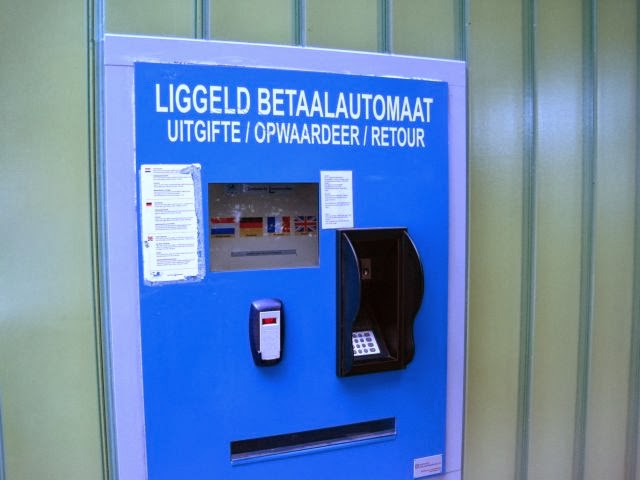
Shopping in the Netherlands is cash or a Dutch credit card. Only big chains like H and M or The Body Shop accept other credit cards. The Netherlands are under pressure from the European Union to revise their policy on “foreign” credit cards such as Visa etc as it is viewed as anti-competitive. The marina and ablution facilities at Leeuwarden are paid for at an automatic machine,
Toilets in Leeuwarden
which thank God, accepts all cards. But no cash! It gives instructions in a choice of Dutch, German or English. You type in boat size, amount of people and add a bit of extra money for electricity or to use the facilities.
The more time I spent in The Netherlands the more I liked the people. They are straight talking, down to earth, wholesome and fun loving. We would speak Afrikaans and they loved it. They are well aware of their role in the history of South Africa and many had travelled there. It’s not unusual for them to make conversation with you and if you ask for help or advice they fall over themselves to provide it.
Hans came onto our boat and pointed out scenic routes on our map, the lorry driver let us follow him all the way to Groningen and another crowd took on a grumpy a bridge keeper for us.
Their mantra is ‘No problem’
Washing machines and dryer in Leeuwarden
or “It’s not a problem.” Whatever you ask, nothing is ever a problem.
One of my best things to do is sit at a cafe and watch bicycles with multiple people, children and pets stacked on them, along with scooters, disabled people in mobility vehicles and pedestrians all vying to move past each other. No helmets. No health and safety procedures. Just plain common sense.
Trying to cross a road is terrifying. They come flying at you from all angles. Pavement, road, pedestrian lane or bike lane or
Waterside eatery Leeuwarden
even a combination of them. No problem to these people. Everyone is all over the place. But somehow, no-one gets hurt. They swerve, slow down, say a quick ‘Sorry’ and move on again. No swearing or road rage. Nothing! It’s amazing.
Since we’re not meat eaters, we were limited in what traditional foods we could eat. Dutch people LOVE frites (French fries) with mayonnaise.
Pancakes, savoury or sweet are also firm favourites with the locals. Stamp pot, if you can find it is yummy. It’s potatoes plus a veggie such as beans, boiled and mashed, with pepper and maybe butter. Dutch people LOVE, LOVE
Shangri La bathroom
coffee. They do serve Italian style coffees but we like koffie verkeerd (coffee wrong) a milky coffee but definitely NOT a latte. Coffee and Appel gebak (apple bake) go together and each establishment prides itself on their version. It’s apple, baked with sugar and cinnamon, in pastry. Often served with slag room (beaten cream).
Belgian beers abound, along with Heineken and Amstel. We like the dark, nutty ones such as Duvel, Afflingem, Leffe and Westmalle. My other half will not eat licorice. I am mad about it. I found gelatin free versions in the health shops and gorged myself on it.
To read about our boating holiday from the beginning – use this link.
To go back to the previous post then – click here. Or read on if you been following the journey.
We ended up spending three nights in Dokkum. My other half was in so much pain from his wrecked back that he needed a few days rest. And to find a physiotherapist. A Google search helped us locate an practice, which we walked to and found. But it had moved! Fortunately someone knew where it had relocated. But then
Saloon and bedroom on Shangri La
they were fully booked. For days ahead!
The one chap kindly agreed to see my husband after his last client late in the day. We went back and the physiotherapist clicked and cracked and pulled him.
We did have travel insurance but we weren’t sure if they would pay for an item like this. It cost €39 which was cheap if it would sort out the pain. And we saved on long distance phone calls and reams of paperwork.
Internet for the most part of this trip wasn’t great. You either had to go to a local coffee shop or pub where they changed the code so often that no-one
Wi-Fi at the local library
ever knew the right access code. If the marina had Wi-Fi, you had to sit right outside the haven (harbour) office to get a signal. Not great in dodgy weather. If you were lucky get signal on your boat, then network was overwhelmed by everyone using it. It was immensely frustrating as the signal would continually crash. Usually just after you have composed a reply to an important e-mail. Dokkum had excellent free wi-fi throughout the marina. What a treat! Most public libraries have free Wi-Fi and the Spar in Lemmer had 30 minutes of free Internet for their customers.
We untied and and re-berthed next to the water
Windmill in Burdaard
supply and loaded up with water. Then, we set off towards Leeuwarden. The canal is beautiful here. It twists and turns passing through lush green countryside. In rural areas the aroma of cow dung does rather permeate the air. But then this is Friesland, home of Friesland cows. Champion milk makers. We are aspirant vegans so we only had milk and cheese if we went out and there were no vegan options.
We travelled through a small town called Burdaard where the houses are right on the canal. Everyone is so friendly in the towns and on the canals. Waving at the people and other boats on the canal was becoming second nature and I found myself wanting to wave even when we went walk-about in the bigger cities. I always thought coffee shops where cannabis is legal were unique to Amsterdam but the smell of weed alerted me to coffee shops in Groningen and in Leeuwaarden. Both are university cities and with a much younger population than in the smaller towns.
Canal aqueduct over a highway
If you plan to meet a Dutch person and they tell you the meeting time is ten thirty, Do NOT think they mean 30 minutes after ten. What they mean is 30 minutes BEFORE ten. So really actually they mean nine-thirty. Fortunately, it’s the same in Afrikaans, so we know this.
Another thing Dutch people do that can be confusing to an English speaking person, is the way they say their numbers. For example a number like 54, would be fifty-four in English. In Dutch, it’s vier en vyftig (four and fifty). Try to read times and bills rather than listen to them to be sure you understand what is meant.
Next time I talk about our time in Leeuwarden, the capital of Friesland. Find that post – here.
Go to – My Holidays and Trips – at the top of this page to read about other places we have visited. Or just click on – this link.