To go to the beginning of Barging in The Netherlands – click here. To pick up from the last post – use this link.
We left our public mooring and motored into the Lauwersmeer which is a lake area just inside the
Lauwersmeer
dijk that holds off the Waddenzee. The narrow canals suddenly became wide open lakes. Also being near the ocean meant increased wind and lots of yachts. Then we found the section of canal that went off to Dokkum. The moat system of canals around a town were not unique to Zwolle. Most towns here seem to have them. In Dokkum we found a mooring with no shore power and basic ablution facilities. We thought it might be a freebie but a woman came and collected €10.40 from us for the night.
By the time we tied up, it was quite late, but
Bridge over moat in Dokkum
we wanted a quick look-see around Dokkum and bumped into Hans and the other two who suggested this route to us. Dokkum is an absolute must.
There is a VVV where you can get guidance. The historic inner city is only about 500m2 so you can go exploring on your own. Look out for two old working mills, museums and loads of ancient buildings. A monument to Saint Boniface (patron saint of Germany) is next to the moorings on the south side of the town. Boniface was bumped off by the locals and relieved of his possessions.
Every town has a market at least one day a
Mooring in Dokkum at night
week. Dokkum sets up on a Wednesday. We were in time, so we did a mini shop-up. Most places have a smallish COOP, a Spar or a little Albert Heijn supermarket. Sometimes both and sometimes even an ALDI or a LIDL. They also have a similar chain called Jumbo where you can stock up on food provisions. The local pharmacy chain is called DA, the health shop chain is G & W and in bigger centres there is an organic fruit and veggie shop called EkoPlaza. You can also find healthy store cupboard items and toiletries there. HEMA sell everything from croissants to underpants, light bulbs to children’s toys.
Our boat was developing a starboard list and stern trim from all the shopping. More boat terms! The first means it tilts slightly to the right and the second means it tilts slightly backward. Which is pretty normal in a boat no matter what size. The position of engines, water, fuel and storage space all affect how a boat will lie in the water. I noticed it when I put dishes in the draining rack in the kitchen. The water always trickled to the one side.
Dokkum by day
We very nearly bought another boat before Shangri La. The year before we bought Shangri La, we fell in love with a boat in Nottingham in the UK. My husband and the seller agreed on a price, filled in the paperwork and decided on a surveyor. The seller was a little reticent in providing what we thought was essential paperwork – deed of sale, VAT registration, etc.
The seller seemed to think we were being persnickety as he said he bought the boat without any of it. It was also a Dutch boat so my husband got hold of the Kadaster. The Kadaster are the Dutch boat registry. My other half gave them a number that was stamped on the boat. Turned out the boat had an outstanding bond or mortgage of €67 000.00.
A car on top of a dijk
My husband mentioned this to the surveyor who advised us not to go ahead and purchase the boat. We must assume the owner bought it in good faith and since it had remained in the UK, he had not had a problem. It’s possible that the boat had been removed from the Kadaster and registered elsewhere and the amount was paid up but the details not amended. But since there was no paperwork to back this up we had no way of knowing what the situation was. We would not have been able to take the boat outside the UK or travel from one country to the next in Europe, which was the whole point of buying the boat. The sale went sour.
The Kadaster in Groningen
With Shangri La, the agent provided all the relevant paper work, some of it even had to be done twice! My husband wanted the boat registered in the UK and the previous owners had jointly owned the boat. The UK MCA or Maritime Coastal Agency wanted two separate bills of sale from each of the owners selling their individual 32/64th share of the boat. Two signatures and 50/50 were not good enough. So the moral of all this is check the paper trail and make sure up front what is required.
To read this travel diary from the beginning please use – this link. To go back to last week’s post – click here.
From Groningen we set off for Appingedam, apparently a beautiful old town. We got stuck waiting for bridges and lost at least 2 hours. But once going, the speed limit of 13 kilometres an hour allowed us to make good time. Yet another wide awake harbour master was waiting for us as we came thought the bridge. Appingedam did not disappoint. It has a brand new marina and is a well maintained historical town. The usual stores Albert Heijn (supermarket), Hema (everything) can be found in the main street. Another attraction are the ‘hanging kitchens’. They are extensions to old buildings to create a cooking area.
We arrived just in time for the Sea Shanty Festival. Now I need to say this, we didn’t purposely plan tofollow each and every single festival in every last town. But it was hard to miss them. Either it was sheer fluke, or August is the month for festivals.
And this particular festival was happening right next to the marina. A mix of different groups of singers rotated venues, even riding up and down the canals, singing sea shanties. Acapella, good old fashioned – “Hey Ho and up she rises” and oompah bands went on for most of our time in Appingedam. We would have moved on sooner were it not for my other half being incapacitated. A person can only take so much mirth.
Hanging kitchens in Appingedam
The boaters in the marina got festive and hung up all their flags plus added bunting. Also known as “dressing overall” in boat speak, creating a festive vibe in the marina. A few boats even had coloured lights draped over their boats at night.
The fresh water supply in Appingedam had a health warning for Legionnaire’s Disease next to the tap. In Dutch only. You need to run all the water out the hose before topping up your tanks and again after. This procedure prevents contamination. We originally wanted to turn down the heating on our boat but the engineer at our home marina advised us not to. He said hot water killed off salmonella which is another lurgie to consider. Who knew?
Skew buildings in Appingedam
One last bit of wise advice we were given, was to ensure we used a 60’C wash at the laundries. Or risk contaminating our clothes/linen from possible bugs from other people’s laundry. Every marina we encountered had a laundry. Usually one washing machine and one dryer. Sometimes two. The machines used tokens, purchased from the marina office. Quite a few machines dispensed soap so washing powder was not necessary. It usually cost around €5 for a wash and a dry, sometimes more. All the machines were in great working order. People tend to remove your washing and place it in a basket if your cycle has ended and they want to use the machine. Some kind person folded my laundry straight from the dryer so well
Public lanudry at marina in Leeuwarden
it looked like it had been ironed.The ablution facilities were also usually in good nick. But not all the facilities had toilet paper or hand soap. We got into the habit of always taking our own just in case.I found the showers cut off too quickly and I needed at least two, sometimes three coins to wash my hair, shave and have a good fat scrub up.
I guess every nation has a misery guts. Or two. We met a pair of Dutch moaners in Appingedam. This couple berthed next to us. We exchanged polite greetings. All good. So we thought.We turned on our generator so we could use our stove to warm up some food and the husband charged up to our boat and told us to turn our engine off. He was allergic to fumes. Lord alone knows how he
Back of our boat after a laundry session
survived all the boat engines on the canals and in the marinas. Such an unreasonable request really should have been ignored but we didn’t want to get into an altercation. So we ate salad and fresh food in Appingedam which could only have been good for us.
From Appingedam we planned to take the Van Starkenborgh Canal and then the Princes Magriet Canal toward Friesland. A friendly crowd in the boat ahead suggested we rather go via the Riet Diep which they said was less industrialised, had less barges – which have right of way, and was more scenic. And it was. We found a peaceful public mooring in the middle of no-where. There weren’t even cows or sheep about. I made a mushroom and courgette curry which we ate with a €3.99 Albert Heijn organic Syrah. And watched the setting sun. Heaven!
Read this travel diary from the start on – this link – or go back to Part 6 – here.
We ended up staying 5 nights in Groningen. For a number of reasons. One reason – there’s an IKEA a 10
Oosterhaven mooring in the city of Groningen
minute walk away and we needed chairs and a table for the deck. We also needed mattress protectors, another pot, tumblers. etc….
Thank God IKEA pack their goods flat, and thank God again, that my husband managed to use boat ropes to fashion carriers for our new out-door furniture. We hooked a chair onto each shoulder and walked back to the boat looking like pack horses. We made three trips to IKEA.
The second reason we stayed on, my other half pulled his back out and was in excruciating pain. We decided to take it easy for a bit. Groningen had a music festival on the go at the Noorder Plantsoen Park. Sadly we never got to see the jazz and blues
artists
The tourist info sign
The outdoor fun festival we saw in Zwolle pitched up in Groningen. Fortunately they were in the inner city, away from the marina this time. Not that the marina was a peaceful place. Two nights in a row a group of people decided to ‘sing’ right next to our boat. At four in the morning! One person tried to play an acoustic guitar. It was one chord, out of key and bad. Another rang their bicycle bell. One more person bashed a bucket. The rest wailed and moaned.
Unlucky for us they came back the next night for an encore but fortunately they gave up after an hour.
The last reason we hung around was because my
Greenie catching up on the blogging
husband’s cousin from the UK was coming to the Netherlands with his Dutch wife. She planned to stay with a school friend. The cousin wanted to spend some time on the water. It would be easier for us to be berthed in a place that was easily accessible. Their plans also went awry when the school friend was rushed to hospital. Then his car tyre blew. But he made it a day late and for a brief period.
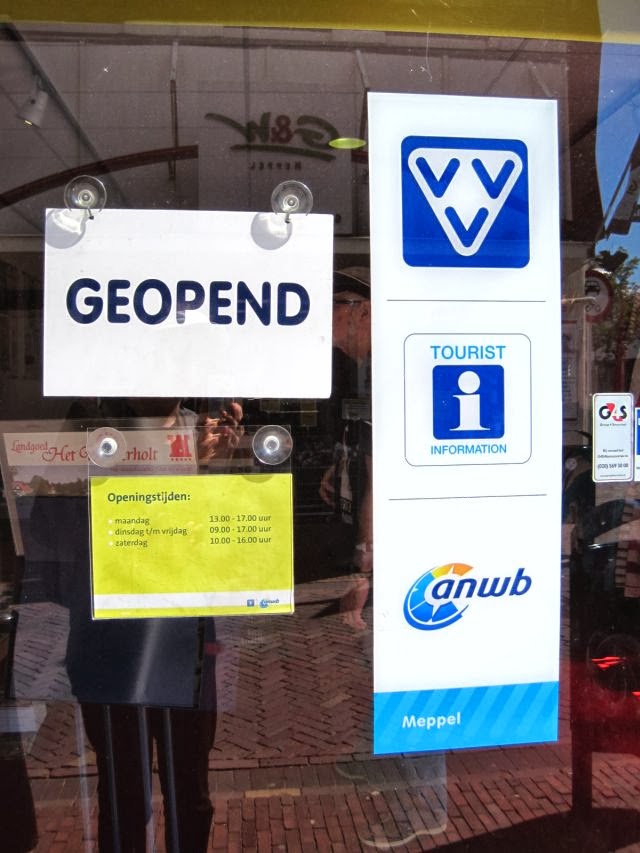
The VVV (pronounced fay fay fay) or Tourism Office is located in the heart of the city in a modern cubist building. You can purchase a map there for €1.95. If you have time you do visit the nautical museum (entrance €6 for adults), or one
Waterway guide and canal map
of the other museums, take an afternoon guided tour, go up the Martini Tower which is 97 metres high, visit the Prinsenhof herb and rose garden, locate the hofjes or shop till you drop. The market in Groningen on Tuesday, Friday and Saterday 9am, to 5pm is supposed to be the second best in Holland. We loved the herb and spice market – De Kruiden Specialist.
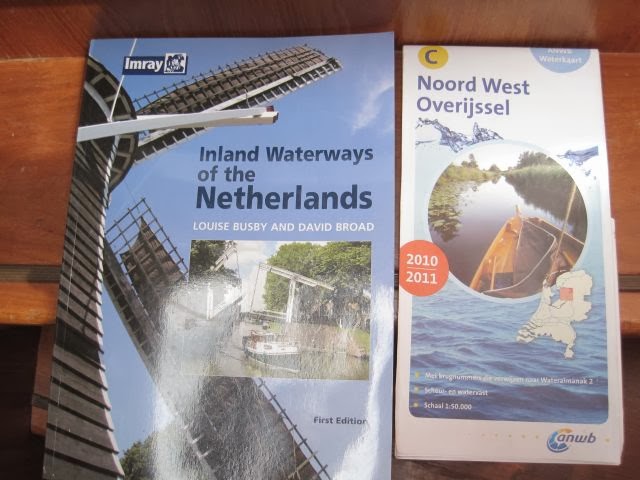
Groningen, like many Dutch cities and towns is surrounded by a moat and interlinking canals. The bridges in and out the city open in a series. Five bridges on-a-trot in, then the same three bridges on-a-trot out. This is great if you get there as they open up at the first bridge. Not so great if you get there as they closing a bridge. You have no choice but to tie up and wait until the bridge manager does the full round and comes back. The bridges do not always have signs telling you how they work. The Wateralmanak is the guide for that info. If you can read Dutch. But even that is not always clear.
Smaller boats have a massive advantage as they can slip under more bridges. Bigger isn’t always better. Yachts with their masts up always have to wait for a bridge to open. For the most part boaties are a super friendly lot. They wave as they pass and chit-chat in the locks or moorings is common. We attracted a lot of interest with our South African flag. We saw plenty German flags, a few British a Swiss flag or two and a Swedish flag. That’s it! But we know from one of the lock-keepers that South Africans have been on these waters. Most Dutchies know exactly where South Africa is. They are well travelled and aware of their role in South Africa’s history. The only miserable people are the fisherwo/men on the banks. But to be fair we’ve found them a grumpy lot on every canal we’ve ever travelled. Fishing can’t be a whole heap of fun. We stopped waving at them.
Next week is about our time in Appingedam. Read that post by – clicking here.
Go to – My Holidays and Trips – at the top of this page to read about other places we have visited. Or just click on – this link.
Read the previous post here – Part 5 – or go back to the beginning of this travel dairy by – clicking here.
We had no idea if we would get going the next day. Much confusion. The Wateralmanak said the bridges closed on Sundays after mid August. Today is 18th August. The harbour master in Meppel said they were open. Since the bridge operators start work at 9.00, we made sure we were ready. And bang on time – the first lock changed lights. A bunch of us raced to untie and get through the lock. Some didn’t make it. That particular lock keeper said all locks and bridges were open all day – except lunch time – of course. We were thrilled. ETA for Groningen was around lunch time.
But that was not to be. Just outside Groningen we came across – Van Ketwich Verschuur Brug Nr 202 M – and they had opened three times a day on Sundays. Boats could pass in one direction only. Since we were stuck outside, we moored up, had a very early lunch and did a spot of reading.
When we first arrived in The Netherlands, we would ask to speak English. In southern Holland they understood our English better than our Afrikaans. But as we headed further north, we found we could speak Afrikaans and most people knew what we saying. Perhaps the Dutch settlers in South Africa came from Drenthe? Or maybe we adapted to speaking a Dutch style Afrikaans?
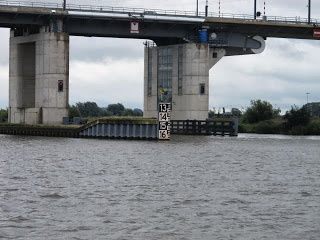
A nice high bridge – see numbers for clearance level
When we first started looking at boats, we had a much smaller boat in mind. We hired different boats in different countries over the years. This helped shape our idea of what was important to us. There were lots of boats we liked, but they were missing this or didn’t have that. The boat agents would show us bigger boats, but they were outside the budget. Eventually we realised that our needs required a bigger boat. My husband had to save for another year.
There are still things that would have been nice to have, such as – a washing machine, two bathrooms for when we have visitors or a
Rotating railway bridge # 506K just outside Meppel
proper oven . . . . To fit all that, a boat size goes up astronomically – as does the price. And the places you can travel or fit into, decrease. Truth is, at 4.7 m air draft, 1.1 m draft, 12.6 m length and 3.6 m wide, we are at the very limit of a medium sized boat. The real question is how much space do YOU need? How much is wasted? And this is where boat design comes in. The design must provide maximum space to move and storage.
Our boat is a Dutch Steel motor cruiser. A van Der Valk. A Gys Van Der Valk boat to be exact. There a two brothers pushing out Van
Quayside in Meppel
Der Valk motor cruisers.You really need to look at styles of boats and hone in on the designs that appeal to you. Then look for the newest one, in the best condition, at the best price.
The rest of our Sunday was slow going. We managed to travel a measly 13 kilometres and our motoring time was 2 hours 45 minutes. All this from 9.00 to 16.00. Not great. We learnt that Sundays on the waterways are slow going. Most of our time was spent waiting for bridges, locks and lock-keepers who managed multiple points alone. These poor guys cycle from one bridge to the next doing a good few in a row. Then start all over again.
Lucky for us we encountered yet another hands-on harbour master at Goningen Oosterhaven. He
Meppel town square
caught our attention chop chop and directed us straight into a berth. We tied up and went on a mini walk-about before it got too dark. After our long day we decided to get brave and have a Belgian beer. My husband had a Westmalle dubbel and I had a . . Delirium Tremens. How could I NOT have one? Then we headed back to inclusive, 10 amp shore power = piping hot shower and kettle boiled water in 10 mins.
Yay!
To read this travel blog from the begining – click here. To go to the previous post – use this link. – See more at: https://greenpointgreenie.co.za/uncategorized/barging-through-netherlands-part-4/#sthash.9F4PLlUF.dpuf
Dutch food menu
To read Barging through the Netherlands from the start – use this link – and to go to the previous post – click here.
Public mooring outside Sluis de Punt
The next morning we got going fairly early to resume our trip north toward Groningen. There are a few early birds on the waterways, but most people only untie and motor off from around 9.00 as the bridge operators and lock keepers start around that time.
You get used to the grating sound of bow thrusters, boat engines (which are often recycled
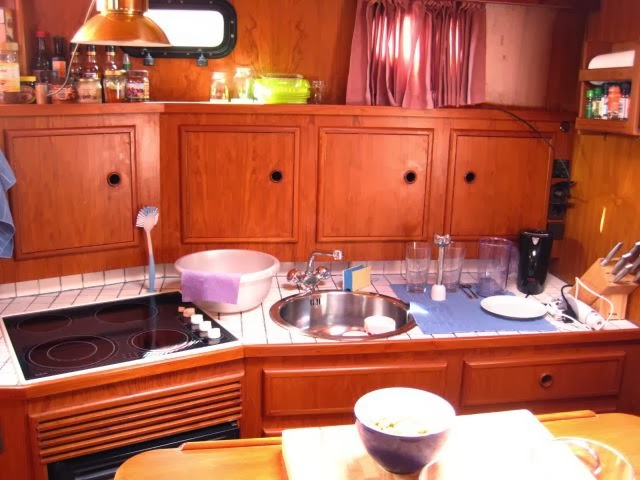
Kitchen/galley on Shangri La
truck engines), and the wash of water as people gear up to travel along the canals. It’s nice to be part of a group en masse. Particularly with locals as they know how the bridges work. We follow right behind them.
Bridges are big, small, lifting, swirling, for cars, for trains, and on and on. Some bridges open fixed times, which are determined by the time of year. On the hour or every half hour. Even only three times a day. At some bridges you have to push a button or use your VHF
Mass exodus of boats shortly after bridge opens
radio to request them to open. And other bridges open on demand. You often see someone lurking in a tower keeping an eye on things. You also get the odd toll bridge where they lower a Dutch wooden clog on a stick for you to put money in.
We knew the trip to Groningen would take a few days. Mainly because of the restrictive speed limit. What was surprising is how few boats were traveling along this unbelievably picturesque route. Maybe the slow speed put them off?
A friendly chap in a tired looking boat was also heading for Groningen so we tailed him. We have yet to encounter a Dutch person who can’t
Lock keeper collecting bruggeld/bridge money in a clog off a rope
or won’t speak English. This chap told us he bought his boat a decade ago. It wasn’t in good nick then. A friend had promised to restore his boat and it just never happened. He had recently retired and decided to take the boat up to Groningen and rather fix it himself. This conversation all happened in the locks as we traveled.
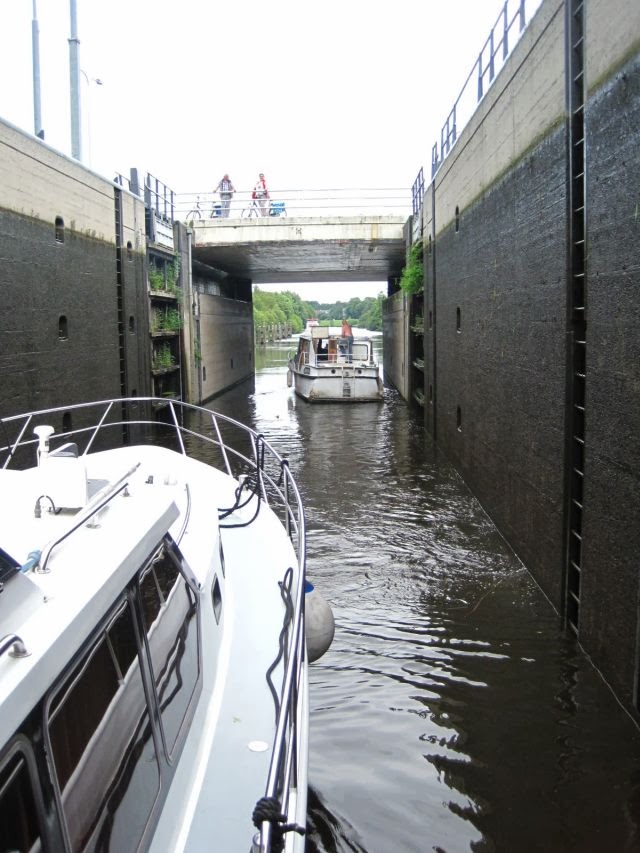
A sluis is a lock in Dutch. Locks are the equivalent of an elevator on the waterways. You drive your boat in. They close the lock doors/gates. The boat goes up or down. The doors open and your drive your boat out.
Fruit and Veg Savers
All the locks we encountered had a lock keeper or a lock keeper-ess. Sometimes two of them. Unlike the French lock keepers, if they see you, and it’s 2 minutes past their lunch time, they will still let you pass. And your lunch time break is often interrupted but the early arrival of a lock keeper back on the job. Mon Dieu!
We over-nighted just outside Sluis De Punt. After a hectic day. For us. Four locks and 22 bridges in 38 kilometres. Our average traveling speed is so slow that a runner comfortably ran past us. Around 8 kilometres an hour.
Our overnight spot was yet another no services public mooring place. After tying up the boat, we decided to do a bit more spring cleaning. The wooden shower grating, the boat ladder we discovered under the seats, a section of the boat cover and some metal mooring stakes all needed a good clean. You can’t use ordinary cleaning agents and
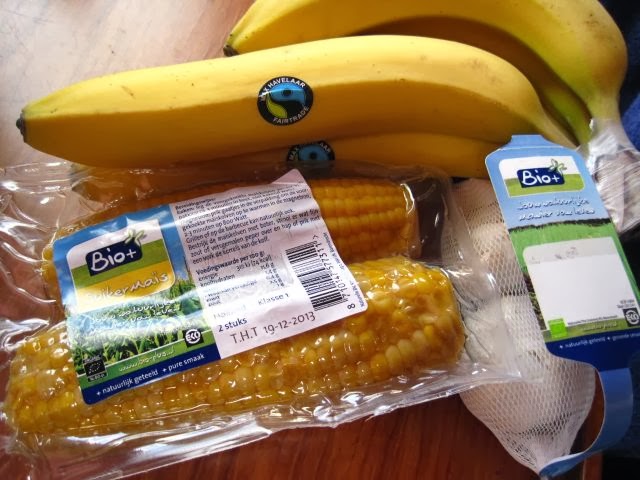
Organic food
dump them into the canals. Not allowed. These items needed a rigorous clean. We could dispose of normal cleaning agents, plus water, on the banks of the canal. It was a lovely evening. I made a monster sized salad with vegetarian ‘balletjies’ or meat balls from the local supermarket chain – Albert Heijn.
Food on this trip was a pleasure. Well, for us it was. We both prefer to eat organic vegan food. Most of our family and friends find our diet austere and a bit extreme. Back home when we eat out with family and friends the wheels unfortunately come off. But on our own we easily stick to our eating habits.
Groningen harbour under a full moon
Most eateries in The Netherlands serve meat and seafood dishes with a portion of ‘frites’ or French fries and a container of mayonnaise. Not our kind of food. We found raw nuts, soy mince, stevia and egg replacer in a health shop. And we found flax seeds, hemp protein powder and cereal coffee in a pharmacy. Even in the smallest town, the local supermarkets had unsweetened soy milk, tinned beans, organic olive oil and honey.
The food markets are excellent. They stock all sorts of fresh produce; mooli (large white radish), Lingen berries and even various coloured onions. It’s usually cheaper to buy fresh produce at the markets. Ten lemons or 5 limes cost €1. We came home with a huge big bag crammed
VVV or Tourist Info office
full which cost us around €14. However, I can’t be sure all of it was organic.
Since we eat a LOT of fresh fruit and veg, my husband bought us a box of Fruit and Veg Savers (find link to them here) which really make a difference. And the previous owners left plastic crates in the hull which is a cool dark place and perfect for additional storage. Our beer and wine, long life soy milk, potatoes, onions and garlic live there.
To read this travel blog from the begining – click here. To go to the previous post – use this link.
We spent two nights in Meppel. Then we headed further north through Assen (pronounced ah-sin) in the
Canal in Drenthe province
province of Drenthe (pronounced Drenter). It’s no surprise that Holland has reclaimed land over the years. But some of it only fairly recently. Lelystad area for example has new buildings, lots of canals for drainage and not many trees. Drenthe province is the complete opposite. Lovely tall trees line the canals and you can see farm houses with heaps of olde worlde charm.
Also noticeable – we encountered locks. The trip from Meppel to Dieverbrug had a combo of 4 locks and 10 bridges in just 21 kilometres. We bought an el cheapo, lightweight pair of gloves for me at the local hardware in Zwartsluis before we left and they were brilliant. Not water-proof, but light and prevented my hands from chaffing with all the rope work in the locks.
The speed limit in this area was much less than we were allowed to travel before. Probably because the canals are shallower and narrower. It took us a far longer to travel less distance. Our engine didn’t get hot enough to heat our shower
Public mooring near Dieverbrug
water. It’s important to check the travel guides so you know these things when planning a route.
That said, I leave all the planning to my husband. He’s a plan-o-holic. I try to listen and take it all in, but I don’t, and then promptly ask stuff he has already told me. In my defence, there is a lot to take in.
We over-nighted in a public mooring just outside Dieverbrug. Marinas have shore power, decent sized showers, hot water, proper toilets and fresh clean water available – at a fee. Most functions use 50c coins. A five minute hot shower = 1 coin, 100 litres of fresh water = 1 coin, shore power = 1 coin per 2 kilowatt hours. Heating water with shore power
Country house Drenthe province
can deplete your coins in half an hour.
You pay to tie up at a marina. The longer your boat, the more you pay. Our boat is 12.6 metres long and 3.6 wide. We paid €11, for two, per night. The fee is more about the length of your boat than how many people on the boat.
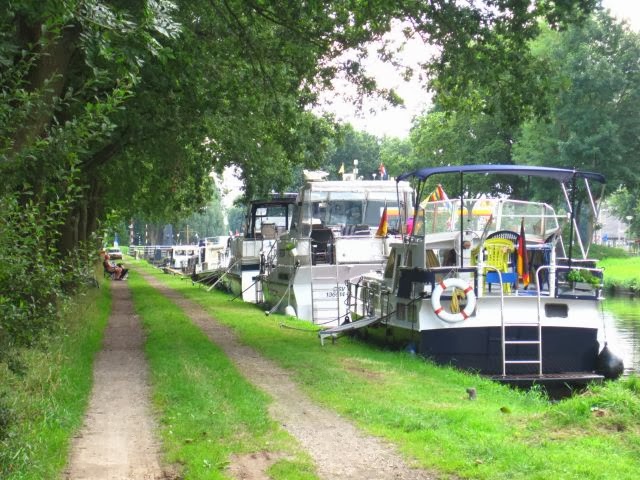
Public moorings are spaces on the side of the canal that offer no more than an bollard to tie up. We needed to use our pegs as some bollards were missing. You use your own water and power supplies.
Sluis (lock) Peelo
A boat is not that different to a caravan, except it’s a different shape and floats. We noticed that marinas often accommodate camper wagons, caravans and tents near the boats. We both agree that we don’t find traveling in a caravan the slightest bit appealing. Can’t explain what the difference is, but we are not campers. Not at the moment.
Now that we have our own boat, half the fun is walking past other boats moored nearby and looking at them. We look at what people have done with their boats and pick up good ideas or wonder what were they thinking? We analyse and compare.
I’ve said before that no two boats are the same from a design and technical aspect. But also how people live on them. Some boats have satellite communication, plush leather seating and designer interiors while others look like rust buckets with mouldy curtains.
The captain and myself
Both owners sit on their decks at night and plain and simply enjoy being on the water. I know super yacht owners compete for bigger, better, more on their boats. When it comes down to it, it’s all about that feeling of having your own boat, and being on it, in the water.
I’m always amazed at how many dogs travel with their parents on these boats. We even saw two cats – on leashes – tied to the side of a particular boat. Inside, they had cat litter trays and two budgies in a cage. One has to wonder how happy a cat is living like that, but I don’t have cats, so I can’t say. The poor budgies can’t have loved living with two cats tied in such close proximity.