I said in my last post I would write about the road trip I have just done which covered nearly 5000 kilometers and spanned four countries in Southern African.
There are plenty similar tours and a plethora of tour operators. We opted to travel with Absolut Tours as my friend is a tour guide with them. We went for a camping and DIY tour to keep costs down.
Up front I have to say that if you are scared of wild animals, not willing to brave the odd cold shower or need a comfortable mattress to sleep, don’t do this kind of holiday.
If, however the idea of listening to lion roaring from your tent, taking a shower with a bush view and happy to cook on an open fire, then this is the way to go.
The terrain was varied. We travelled through savanna into the desert, back to semi arid bushveld and on to lush vegetation in the Caprivi Strip.
We saw the Fish River Canyon which is the second largest in the world and the Victoria Falls which are the third largest in the world. There were game reserves galore and loads of wild animals, birds, reptiles and insects.
Tarred roads are not common in the south.
Our truck for the 16 day trip was a customised Toyota Hino. It was designed for long road trips. It carried two chest style refrigerators, trestle tables, gas bottles, tents, luggage, fold up chairs, food provisions, water, gas cooking appliances and 16 of us.
South African/Namibian border control.
The truck collected us from the hotel where the German visitors were staying and we set off at 08.00am on the West Coast/Namibia road. That was the last time we got going that late until we had our last night at the Elephant Hills Hotel in Zimbabwe.
We were a mixed group of mostly German speaking travellers and two South Africans. The Germans had spent the last few days prior to the trip seeing the sights of Cape Town.
We had huge distances to cover with games drive, bush study excursions or boat tours to fit in as well, so early starts to the day were mandatory. The truck made it’s way along the west coast of Cape Town and then headed toward Springbok.
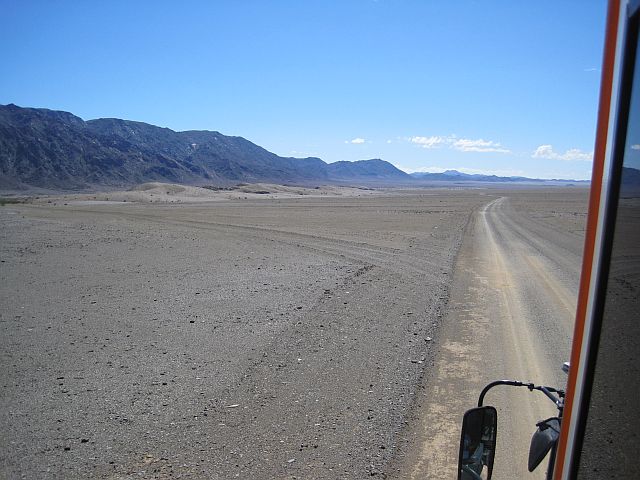
Typical Namibian gravel roads.
On our first day we did the longest distance. The plan was to get to Namibia as soon as possible. We pitched our tents just outside of Springbok and learned the routine fast. Pitch tents, get the fire going, set up tables and chairs, prepare and cook food, eat, shower and go to bed.
Our first evening meal was a fish braai (BBQ), Greek salad and garlicky potatoes. There was plenty beer, cider and wine to go with our meal.
I was so grateful that our guide and friend is inclined to healthy fresh food and a very good cook. As the only vegetarian in the group I feared I may end up going hungry. It has happened to me. I ate well. Can’t promise that all guides will be like the one we had.
I am leaving in a day for a camping trip into Southern Africa. It’s going to be three weeks of dirt roads and dust. Sleeping in tents and getting up close and personal with nature. My usual weekly posts on what’s going on in Cape Town will take a short holiday. I don’t expect much communication in the bush and am disinclined to want to subject my precious laptop to the current crisis floods in Northern Namibia, endless bumpy roads and piles of fine dust.
When I get back I will share what our neighbouring countries look like in a few posts. Sixteen of us, in a big overland truck, will be going up the west coast of South Africa into Namibia. When I say big truck, I probably should say seriously big truck. The vehicle is 4.1m high, 2,5 m wide and 9,5m long. It is carrying our food, tents, cooking utensils and us.
The tour includes the Fish River Canyon and Ai Ais hot springs, then it heads up and toward the coast where we stay in Swakopmund. From there we go further north to the Caprivi strip and into the Ethosha and Okavango swamp area. Then we head across to Botswana and Chobe Game Reserve. We finally end up in Zimbabwe and Victoria Falls. It’s a long journey.
I will also be spending a few days in the city of gold aka Johannesburg aka Gauteng, also known as Egoli. How does one city get to have so many names? Hopefully, I will get to ride the new Gautrain. I’m told it makes the London underground or the Paris metro look old and ugly. Have to see for myself.
Watch this space!
Just discovered that the study of lighthouses is known as pharology. Who knew? And who knew Princess Anne is an amateur pharolgist? So there you go.
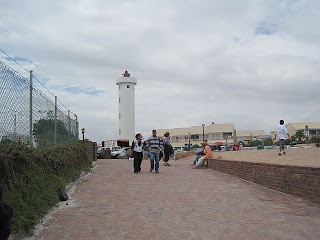
Cape Town is home to a good few working lighthouses. Our lighthouses are not silent as they are in many parts of the world. Each lighthouse has a unique signal and light character that distinguishes them from other lighthouses. When it gets damp foggy the sound of Mouille Point lighthouse permeates the atmosphere as she calls out to the ships.
The first ever lighthouse in Cape Town was lit on the night of 12th April 1824. It had two lanterns that burned using sperm oil. It is no longer working but can be seen at the Waterclub, which is also where the maritime college is. It’s short walk from the Waterfront.
If you happen to be there, you could take in a silver service meal at the hotel school. For bargain prices you can be waited on by the hospitality students. I highly recommend the food and service.
If you are taking a tour or drive in Cape Town then look out for our lighthouses. They can be found in Green Point, Robben Island, Milnerton, Simons Town, Cape Point, Kommetjie and Hout Bay. Further afield there are lighthouses at Cape Agulhas, Gansbaai, Kleinmond, Paternoster and Mossel Bay. Click here for a full list of lighthouses – lighthouses of South Africa
You can take a tour of the lighthouses and some even have holiday cottages where you can stay. For more on Mouille Point lighthouse click here lighthouse and shipwrecks and here Mouille Point lighthouse.
Go to – My Holidays and Trips – at the top of this page to read about other places we have visited. Or just click on – this link.
The really handy thing about living in Cape Town is that I get to read local news and experience new venues and events. Often first hand. It makes for easy access to news and ideas for blog posts. But every now and again I come across something on the net or elsewhere that inspires me. Something a bit different.
Today’s post is frankly useless information. But interesting never the less. The following bigger, better or mosts are found only in South Africa: –
Largest land mammal – elephant
Smallest mammal – least dwarf shrew
Tallest – giraffe
Biggest bird – ostrich
Fastest mammal – cheetah
Largest reptile – leather back turtle
Largest fish – white shark
For more useless information on South Africa and to hear the actual sounds of the bush at night, the cry of a fish eagle or a lion roar follow this link ZAR. You can also listen to local music and hear a few words in Zulu or Afrikaans. For more local trivia visit this post – slang and diski dancing or this one – funny place names.
And a final piece of trivia is that Cape Town celebrates her birthday on 2nd April. She will be 359 years old and if you’re in Cape Town, head to the castle for her birthday party.
Photo courtesy Ed Scott
I went walkabout in the recently opened biodiversity park in Green Point last week. The intention was to create a calming, cool, green place for people in the middle of the city. They got it right.
I must admit I could have done without the helicopter from 07.00 the morning on a local public holiday filming Denzel Washington and Ryan Reynolds over and over and over and over again. They had to come really low to film so you can imagine just how noisy it was. Why do these guys need to film one scene trillions of times? But OK they’ve gone now.
The park is 12.5 hectares in size and has walkways, a cycle lane around the perimeter, seating and ponds. There are boards with information on indigenous plants, medicinal plants, edible plants and biodiversity.
They have cute little hand crafted beaded creatures and animal silhouettes from old rusted metal.
The park is a work in progress. An educational centre to train people in the practice of diversity is on the cards. It is irrigated using spring water from the Oranjezicht spring which is channeled into a canal and then re-used.
Don’t forget that in close proximity to the park are the Metropolitan Golf course, Mouille Point Lighthouse, the beach, a couple of museums including the medical and navy museum. And of course the V and A Waterfront. On the other side of the park is trendy Green Point. The main road which runs next to the park has cafes, restaurants and bars galore. It’s a nice walking day trip.
Photo courtesy of Gillian Ress
Go to – My Holidays and Trips – at the top of this page to read about other places we have visited. Or just click on – this link.