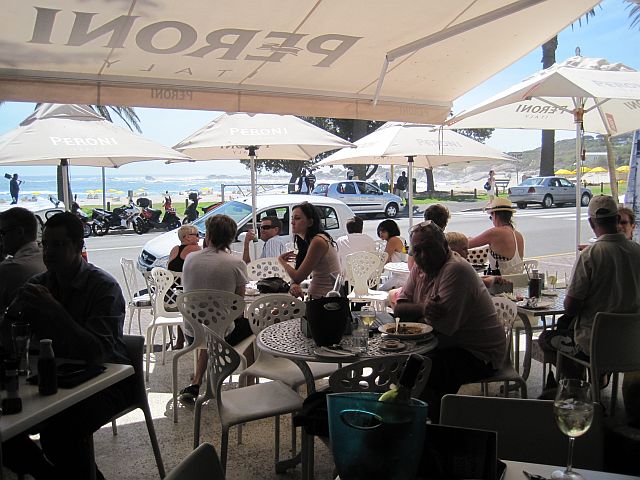
The really handy thing about living in Cape Town is that I get to read local news and experience new venues and events. Often first hand. It makes for easy access to news and ideas for blog posts. But every now and again I come across something on the net or elsewhere that inspires me. Something a bit different.
Today’s post is frankly useless information. But interesting never the less. The following bigger, better or mosts are found only in South Africa: –
Largest land mammal – elephant
Smallest mammal – least dwarf shrew
Tallest – giraffe
Biggest bird – ostrich
Fastest mammal – cheetah
Largest reptile – leather back turtle
Largest fish – white shark
For more useless information on South Africa and to hear the actual sounds of the bush at night, the cry of a fish eagle or a lion roar follow this link ZAR. You can also listen to local music and hear a few words in Zulu or Afrikaans. For more local trivia visit this post – slang and diski dancing or this one – funny place names.
And a final piece of trivia is that Cape Town celebrates her birthday on 2nd April. She will be 359 years old and if you’re in Cape Town, head to the castle for her birthday party.
Photo courtesy Ed Scott
I went walkabout in the recently opened biodiversity park in Green Point last week. The intention was to create a calming, cool, green place for people in the middle of the city. They got it right.
I must admit I could have done without the helicopter from 07.00 the morning on a local public holiday filming Denzel Washington and Ryan Reynolds over and over and over and over again. They had to come really low to film so you can imagine just how noisy it was. Why do these guys need to film one scene trillions of times? But OK they’ve gone now.
The park is 12.5 hectares in size and has walkways, a cycle lane around the perimeter, seating and ponds. There are boards with information on indigenous plants, medicinal plants, edible plants and biodiversity.
They have cute little hand crafted beaded creatures and animal silhouettes from old rusted metal.
The park is a work in progress. An educational centre to train people in the practice of diversity is on the cards. It is irrigated using spring water from the Oranjezicht spring which is channeled into a canal and then re-used.
Don’t forget that in close proximity to the park are the Metropolitan Golf course, Mouille Point Lighthouse, the beach, a couple of museums including the medical and navy museum. And of course the V and A Waterfront. On the other side of the park is trendy Green Point. The main road which runs next to the park has cafes, restaurants and bars galore. It’s a nice walking day trip.
Photo courtesy of Gillian Ress
Go to – My Holidays and Trips – at the top of this page to read about other places we have visited. Or just click on – this link.
We run a guest house and we have noticed some visitors are nervous of South Africa. Traveling can present challenges. Fears usually relate to quality of food and water, crime, insects such as mosquitoes, roads, Hepatitis A or B, parasites and HIV AIDS.
In rural areas where there is stagnant water and poor living conditions there can be some risk of diseases such as cholera, bilharzia, typhoid and rabies. But in Cape Town it is very unlikely.
Since my blog is focused on Cape Town I am not going to even talk about that sort of travel.
Firstly tap water in Cape Town is perfectly safe to drink. Mentioned this topic before in another post see here – tap water. Malaria does not occur in Cape Town. Spoke about this in more depth here – malaria.
Here are the safety precautions I would suggest.
Don’t swim in the sea without a lifeguard present. The current and backwash off the Cape Coast can be strong. And we have sharks in False Bay.
Do not have unprotected sex with a stranger. HIV AIDS rates are high in this part of the world and Hepatitis is also sexually transmitted.
Do wear full factor sunscreen, a hat and body covering clothing if you are out in the sun.
Do not flash valuables and be careless with your handbag, cellphone, laptop or camera.
Don’t go wandering to known unsafe areas or darkly lit places alone at night.
Keep an eye open for wild animals on road trips. Baboons for example can get violent. Read here – Chacma baboon.
Mini bus taxis are a law unto themselves. Just let them go and know you are a better person for it.
Don’t go up the mountains alone or unprepared. The weather can change in minutes and the heavy cloud makes it impossible to find your way home. There have been muggings on the mountains.
Avoid street kids and beggars. They will try and engage you. Just ignore them and walk on. If you want to make a difference rather make a donation to a place of safety or rehabilitation centre. Those sad looking kids are accomplished pick pockets.
Luckily we aren’t likely to have natural disasters. We hardly ever get lightening and thunder storms in the Cape. No fault lines here, so we don’t fear earthquakes. We don’t have volcanoes and we don’t get tsunamis. It seldom snows here, so no avalanches or blizzards either. It can get windy and it can get hot. Mountain fires can get fierce at times. In winter it rains a lot. But we’re pretty lucky here when it comes down to it. For more travel and safety tips follow this link – Travel and safety tips.
In the last post I gave ideas for budgeting. In this post I wanted to talk about how to get hold of local currency. I think it is fair to say that Africa falls into a big broad category in many people’s minds. Having been to Zanzibar Island, Swaziland, Zimbabwe and even parts of South Africa, I am aware that getting hold of cash and banking transactions can be um, tricky.
Cape Town and most of South Africa is pretty much first world with regard to banking. Obviously the more rural and rustic the area you visit, the less likely you are to have modern means. Big cities have the usual operators like Thomas Cook and American Express. Our local banks have a bureau de change office in the bigger banks.
You should easily be able to draw cash from a hole in the wall and use your credit cards in South Africa. We call our cash machines ATMs, short for auto teller machines. Just be aware that not all petrol vendors accept plastic. And do exercise caution withdrawing large sums of money from isolated auto cash machines at night.
It’s worth a mention that South African banking systems have not been victim to the disasters that many western banks have. We have strict laws pertaining to loans and mortgages. It’s harder to owe money here. Which is a good thing if you ask me.
I have been forwarded a link for a competition for a free holiday into Africa. I am heading off in a month to do a Southern African trip from Cape Town, through Namibia, into Botswana, then Vic Falls and I end up in Gauteng or Johannesburg. Maybe you can win a trip? Here is the link competition.
I thought I would give some indication in this post as to what typical items might cost in Cape Town. This does not take into account flights to and from the city.
Firstly an airport shuttle from the airport to the inner city will cost around R350 excluding tip for driver. You can visit the Rikki webpage for their exact prices here – Rikkis taxis. I would use the new MyCiti airport shuttle bus which stops at the Civic Center in the heart of Cape Town and is only R50. From there you can catch a taxi which usually costs R10/km. Here is a taxi link – Cape Town taxi.
Accomodation varies obviously depending on what you are getting. Backpackers range from R250 to about R400 per room. B and B’s or guesthouses start at about R550 going up to R1200 per room. High end fancy hotels and funky art type places start at R1500 and they can reach big bucks. Visit this link to view accomodation – Sleeping Out.
Eating out is also an area where you can pay vast sums or not. It’s up to you. I LOVE the Kauai and Osumo fast food chains. But then I happen to prefer fresh and vegetarain food. You can get a breakfast wrap for R35 or a smoked salmon salad for just over R50. A large coffee will set you back about R16. Do have a look at their menu here – Kauai. If you want to go large then buy a copy of the local Eat Out guide or read it on-line here – Eat Out. Expect wine prices to start at around R80 a bottle at the average eatery. A main meal at a high end establishment will set you back about R150. See Savoy Cabbage menu here – Savoy Cabbage menu
Typical entrance fees to museums range from R15 to about R50. Tours start at around R500. Here is a link to what is on offer – Book Cape Town tours and you can expect to pay R170 for a return trip in the cable car on Table Mountain. A link to Table Mountain is here – Table Mountain.