Supper at Sossusvlei camp was Chilli con carne, carrot salad and coleslaw. I got Chilli non carne. Amazing what our guide was able to make on an open fire. She even made an apple crumble one evening. The focus was typically on local food so she cooked things like Kudu steak, Ostrich burgers and Springbok saussages. She also had a lot of German wurst type things.
The guy who was not well at the outset of the tour soon passed his bugs around and most of us had a turn to feel sick. Fortunately it was nothing serious or enduring and an early night or two did the trick.
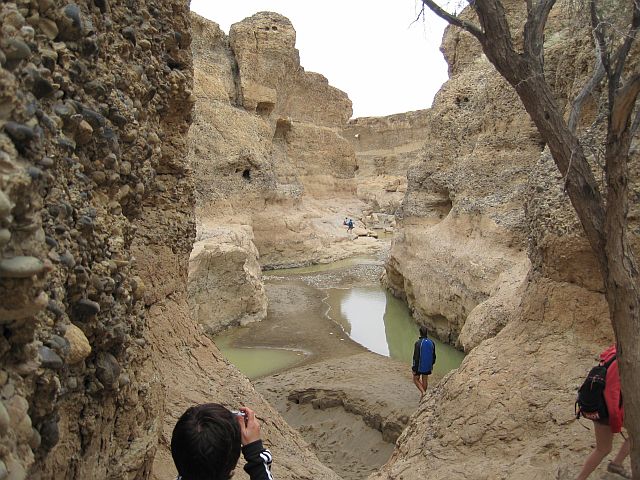
Sesriem Canyon.
At Sossusvlei camp, around 02.00am, an almighty storm passed over us. Our poor tent was tugged by the raging wind. Thunder and lightening cracked overhead. I did wonder if pitching our tent under a tree was such a good idea after all. My tent mate and I quickly closed the tent “windows”. Our rain protective “roof” blew off but we found it the next day.
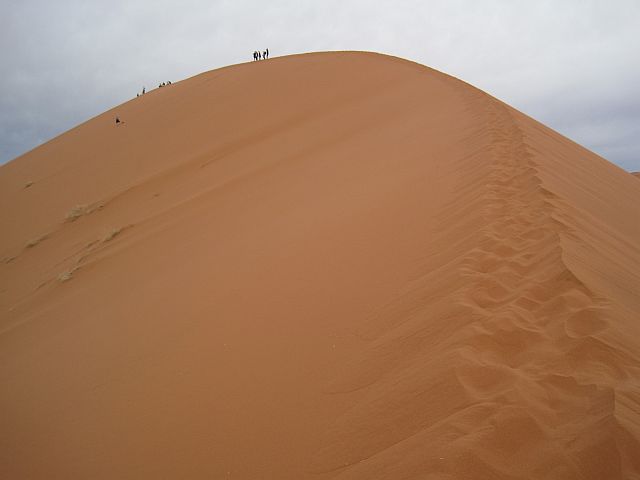
We got up very early to do what is clearly a custom in this part of the world and that is watch the sunrise atop Dune 45. I have never climed a sand dune before. It’s like sea sand. As fast as you step, your feet slide backwards. It’s tiring. But most of us got to the top. Sadly there was no sunrise as it was a cloudy day. Dune 45 is 180 meters high.
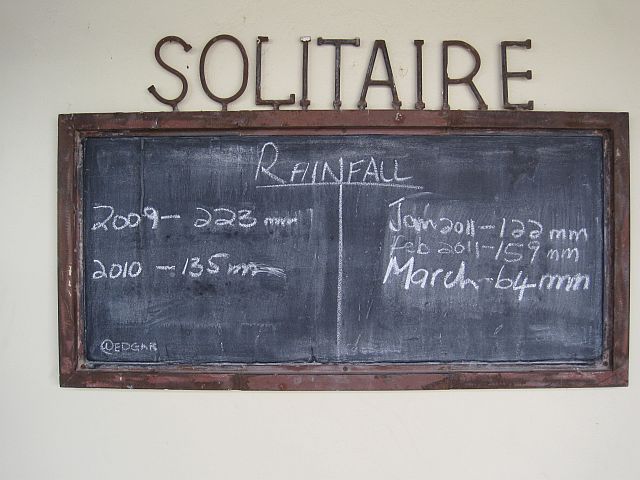
Rainfall 2001 in Namibia
We joined the masses for breakfast as we came down from the dune. It’s a bit strange to be in a desert with sand as far as the eye can see and the smell of bacon and coffee in the air.
After brekka we took the obligatory Namibian tourism trucks and went to see Sossusvlei proper and Death Vlei. A vlei is a marsh. The moving dunes had blocked the water supply to Death Vlei which had completely dried up.
It was while waiting for the tourism truck to collect us again that we got sandblasted in a sandstorm. It felt like hours before they collected us. We stood huddled together with sand in our eyes, ears, nostrils and hair while exposed skin was being exfoliated. Like I said, not fun.
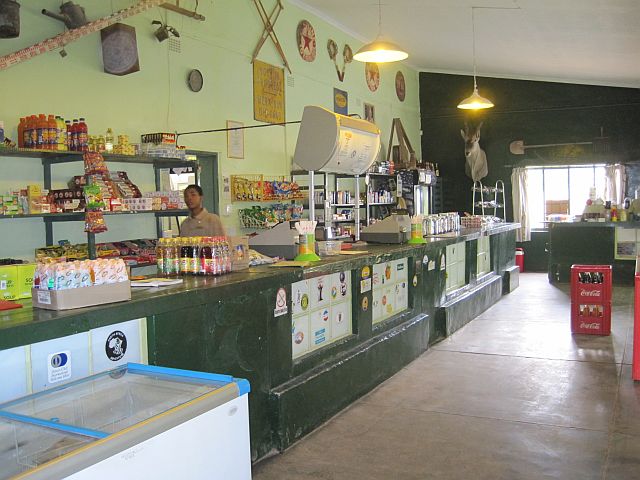
Shop in Namibia
You could see the sand blowing the dunes and get a sense as to how they would move.
Back at the campsite the wind had blown a couple of our tents completely onto their heads. And then . . . . more rain. We sat huddled in the bus for lunch. That was kind of when it was dawning on us that there had been and might still be a lot of rain in Namibia.
Desert garden at one of the stops
So, we gave up the campfire idea and made our way to the bar where we tucked into red wine and cider and got to know each other. We had a pub dinner and it turned out to be a fun evening.
Woke up the next morning to a perfect day. It was hard to believe the previous day was so windy and miserable. Had our usual al freso breakfast listening to the birds and each other.
We piled our gear and ourselves back onto the truck and headed east toward the ocean and the town of Swakopmund. I found an olde worlde charm about a lot of the towns and truck stops in Namibia. The population is only 2 million and they seem to have gone about life somewhat removed from the rest of the world. A sort of naive eccentricity exists in many places that is so captivating and refreshing.
One of the guys on the trip arrived with a cold and was feeling rubbish. We stopped in Springbok to find a pharmacy, but being a Sunday, plus Springbok is a really remote and small place, everything was closed. We decided to move on over the South African/Namibian border and head toward Ai-Ais.
As a South African I have found immigration in many places rather trying. Because you come from Africa, it is just assumed you are desperate to defect and become a refugee in another country. Actually plenty of us are quite happy in Africa. Thankfully I had no trouble at all entering any of the Southern African countries we visited.
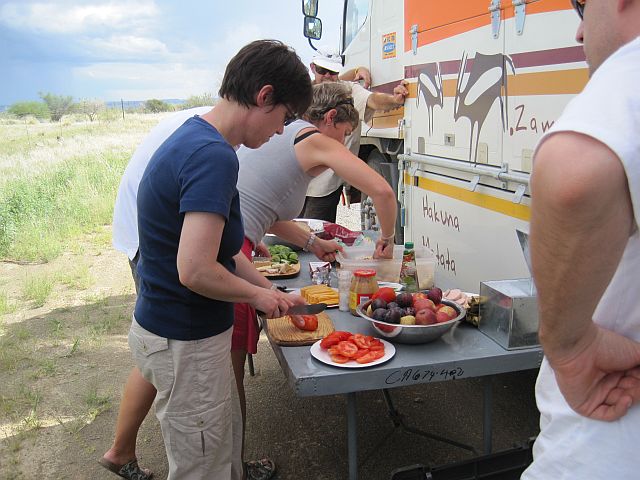
Lunch stop.
We mastered the routines quite quickly. Lunch was typically at a roadside stop. We would haul out our food and tables and set about washing fresh fruit and preparing sandwiches with cheeses and different meats.
Most people in our group helped out with the various tasks and that made it so much easier. We did have one couple that were inclined to fear when their next meal would come and ate far more than their share. This did mean others missed out on food at times. It’s amazing how group dynamics work when people don’t play fair. These two soon become very unpopular.
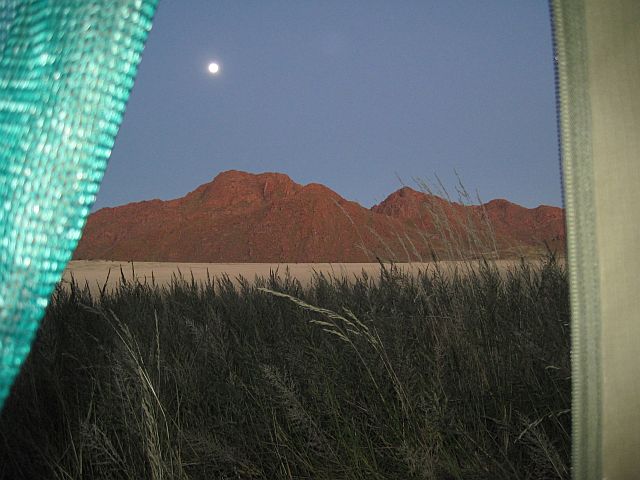
View of Tiras mountains and morning moon from the tent.
We crossed the Orange River at the border. I have done some river rafting there before. There are masses of vineyards in what is a barren area. Water from the Orange River is used to irrigate vineyards along the river.
Ai-Ais is a hot spring situated at the southern end of the Fish River Canyon. We got to our campsite early and were able to have a relaxing afternoon and pitch our tents in the light of day. Some of us lounged by the pool, others visited the spa and the rest watched sport at the bar.
Our driver removed aircon fan belt.
Namibian time is one hour earlier and we got a bit mixed up. We left later that we should have. We regretted this when we had to pitch our tents in the dark at our next stop. Our next stop was on a private farm nestled in the Tiras mountains.
We saw Oryx, Springbok, jackals, Gemsbok, feral horses and plenty bird life on the road travelling to our next stop. I didn’t realise that the desert could be so windy. We encountered a sandstorm when we visited the dunes. Not fun!
Dune 45 near Sossusvlei. Those are people on top.
We also had to take quite a few detours due to the prolific rains that Namibia had experienced. Northern Namibia was declared an area in a state of emergency by president Pohamba. The route via Seeheim had a detour due to flooded roads which added yet more time to our journey.
We did a morning walkabout with the owner of the farm. She showed us bushman paintings, medicinal plants and explained how the bushman lived in the area.
Then we headed off toward our next campsite in the Sossusvlei area. We went through a hailstorm which almost never happens in Namibia. Sossusvlei is dune and desert territory.
The really handy thing about living in Cape Town is that I get to read local news and experience new venues and events. Often first hand. It makes for easy access to news and ideas for blog posts. But every now and again I come across something on the net or elsewhere that inspires me. Something a bit different.
Today’s post is frankly useless information. But interesting never the less. The following bigger, better or mosts are found only in South Africa: –
Largest land mammal – elephant
Smallest mammal – least dwarf shrew
Tallest – giraffe
Biggest bird – ostrich
Fastest mammal – cheetah
Largest reptile – leather back turtle
Largest fish – white shark
For more useless information on South Africa and to hear the actual sounds of the bush at night, the cry of a fish eagle or a lion roar follow this link ZAR. You can also listen to local music and hear a few words in Zulu or Afrikaans. For more local trivia visit this post – slang and diski dancing or this one – funny place names.
And a final piece of trivia is that Cape Town celebrates her birthday on 2nd April. She will be 359 years old and if you’re in Cape Town, head to the castle for her birthday party.
Photo courtesy Ed Scott
We run a guest house and we have noticed some visitors are nervous of South Africa. Traveling can present challenges. Fears usually relate to quality of food and water, crime, insects such as mosquitoes, roads, Hepatitis A or B, parasites and HIV AIDS.
In rural areas where there is stagnant water and poor living conditions there can be some risk of diseases such as cholera, bilharzia, typhoid and rabies. But in Cape Town it is very unlikely.
Since my blog is focused on Cape Town I am not going to even talk about that sort of travel.
Firstly tap water in Cape Town is perfectly safe to drink. Mentioned this topic before in another post see here – tap water. Malaria does not occur in Cape Town. Spoke about this in more depth here – malaria.
Here are the safety precautions I would suggest.
Don’t swim in the sea without a lifeguard present. The current and backwash off the Cape Coast can be strong. And we have sharks in False Bay.
Do not have unprotected sex with a stranger. HIV AIDS rates are high in this part of the world and Hepatitis is also sexually transmitted.
Do wear full factor sunscreen, a hat and body covering clothing if you are out in the sun.
Do not flash valuables and be careless with your handbag, cellphone, laptop or camera.
Don’t go wandering to known unsafe areas or darkly lit places alone at night.
Keep an eye open for wild animals on road trips. Baboons for example can get violent. Read here – Chacma baboon.
Mini bus taxis are a law unto themselves. Just let them go and know you are a better person for it.
Don’t go up the mountains alone or unprepared. The weather can change in minutes and the heavy cloud makes it impossible to find your way home. There have been muggings on the mountains.
Avoid street kids and beggars. They will try and engage you. Just ignore them and walk on. If you want to make a difference rather make a donation to a place of safety or rehabilitation centre. Those sad looking kids are accomplished pick pockets.
Luckily we aren’t likely to have natural disasters. We hardly ever get lightening and thunder storms in the Cape. No fault lines here, so we don’t fear earthquakes. We don’t have volcanoes and we don’t get tsunamis. It seldom snows here, so no avalanches or blizzards either. It can get windy and it can get hot. Mountain fires can get fierce at times. In winter it rains a lot. But we’re pretty lucky here when it comes down to it. For more travel and safety tips follow this link – Travel and safety tips.
In the last post I gave ideas for budgeting. In this post I wanted to talk about how to get hold of local currency. I think it is fair to say that Africa falls into a big broad category in many people’s minds. Having been to Zanzibar Island, Swaziland, Zimbabwe and even parts of South Africa, I am aware that getting hold of cash and banking transactions can be um, tricky.
Cape Town and most of South Africa is pretty much first world with regard to banking. Obviously the more rural and rustic the area you visit, the less likely you are to have modern means. Big cities have the usual operators like Thomas Cook and American Express. Our local banks have a bureau de change office in the bigger banks.
You should easily be able to draw cash from a hole in the wall and use your credit cards in South Africa. We call our cash machines ATMs, short for auto teller machines. Just be aware that not all petrol vendors accept plastic. And do exercise caution withdrawing large sums of money from isolated auto cash machines at night.
It’s worth a mention that South African banking systems have not been victim to the disasters that many western banks have. We have strict laws pertaining to loans and mortgages. It’s harder to owe money here. Which is a good thing if you ask me.
I have been forwarded a link for a competition for a free holiday into Africa. I am heading off in a month to do a Southern African trip from Cape Town, through Namibia, into Botswana, then Vic Falls and I end up in Gauteng or Johannesburg. Maybe you can win a trip? Here is the link competition.
I thought I would give some indication in this post as to what typical items might cost in Cape Town. This does not take into account flights to and from the city.
Firstly an airport shuttle from the airport to the inner city will cost around R350 excluding tip for driver. You can visit the Rikki webpage for their exact prices here – Rikkis taxis. I would use the new MyCiti airport shuttle bus which stops at the Civic Center in the heart of Cape Town and is only R50. From there you can catch a taxi which usually costs R10/km. Here is a taxi link – Cape Town taxi.
Accomodation varies obviously depending on what you are getting. Backpackers range from R250 to about R400 per room. B and B’s or guesthouses start at about R550 going up to R1200 per room. High end fancy hotels and funky art type places start at R1500 and they can reach big bucks. Visit this link to view accomodation – Sleeping Out.
Eating out is also an area where you can pay vast sums or not. It’s up to you. I LOVE the Kauai and Osumo fast food chains. But then I happen to prefer fresh and vegetarain food. You can get a breakfast wrap for R35 or a smoked salmon salad for just over R50. A large coffee will set you back about R16. Do have a look at their menu here – Kauai. If you want to go large then buy a copy of the local Eat Out guide or read it on-line here – Eat Out. Expect wine prices to start at around R80 a bottle at the average eatery. A main meal at a high end establishment will set you back about R150. See Savoy Cabbage menu here – Savoy Cabbage menu
Typical entrance fees to museums range from R15 to about R50. Tours start at around R500. Here is a link to what is on offer – Book Cape Town tours and you can expect to pay R170 for a return trip in the cable car on Table Mountain. A link to Table Mountain is here – Table Mountain.